Deep dive
The New Gloss
After several years of matte surfaces, limewashed walls and natural materials, shine is returning. Lacquer, chrome, mirrors and reflective surfaces are shaping a new kind of elegance at home.
Read the guidePatina, aged materials and traces of time are shaping a new kind of luxury where old things do not need to be restored to perfection. Faded grandeur is about rooms that carry their history with pride.
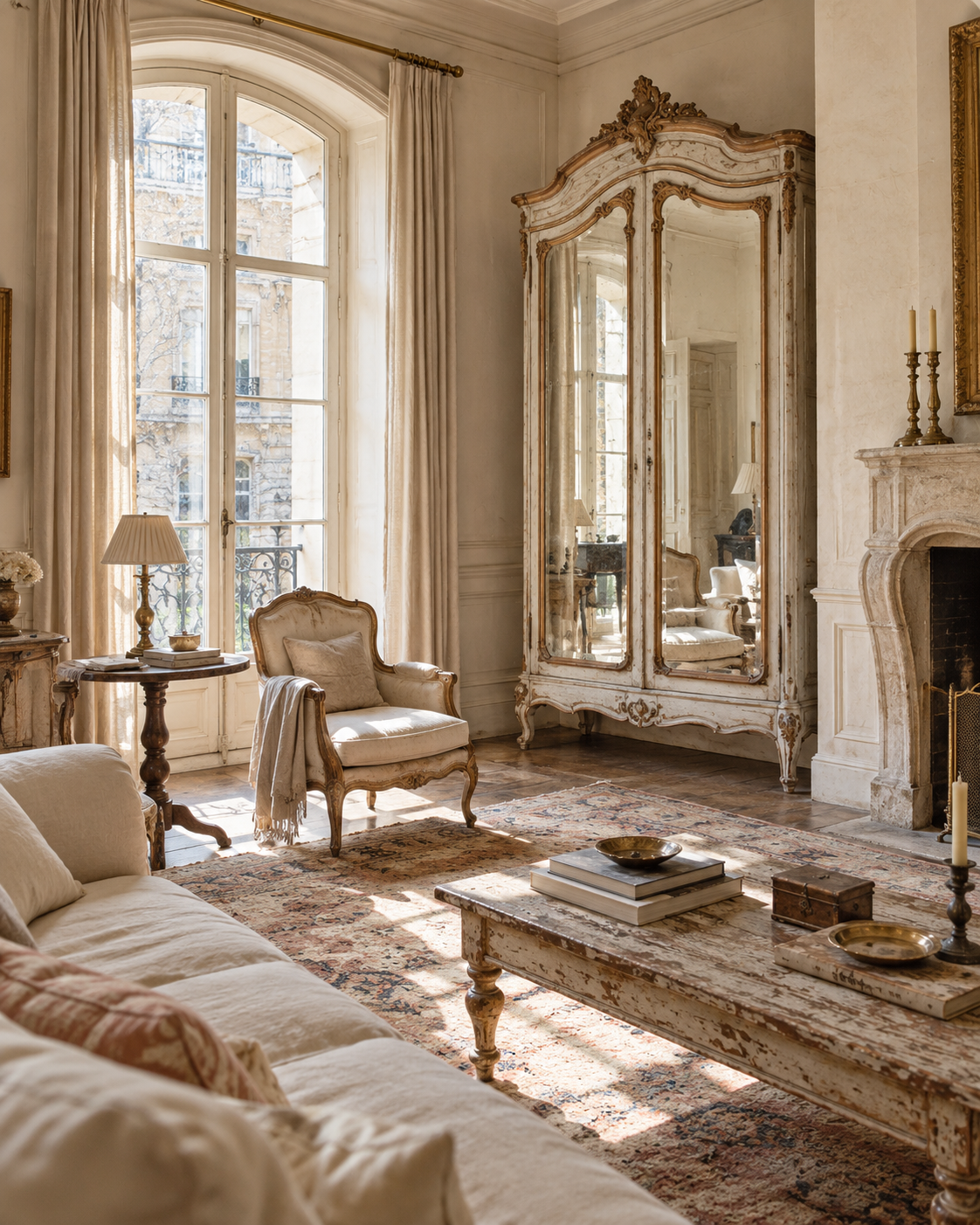
There is a certain kind of perfection that is beginning to feel less interesting.
A freshly painted wall without a single mark.
A completely untouched floor.
Furniture that still looks factory-new.
A room in which everything appears to have arrived in the same week.
At the same time, some of the most compelling interiors are moving in the opposite direction.
Towards rooms whose surfaces have already lived.
House & Garden describes many of 2026’s strongest interiors as warmer and more relaxed, with natural fibres, texture, patina and carefully chosen antiques taking precedence over overly polished perfection. The magazine has also explored how patina in timber, metal and stone has become central to our desire for authenticity and history at home.
Livingetc goes further, describing old as the new luxury: provenance, patina and the thrill of finding something becoming stronger status signals than simple newness.
Not every material improves with age.
But some do.
Solid timber.
Brass.
Bronze.
Leather.
Natural stone.
Linen.
Handmade ceramics.
Their surfaces change. They darken, fade, scratch and soften.
House & Garden identifies exactly this as one of the differences between interiors that age beautifully and those that date quickly: the best rooms are built gradually and allow materials and objects to evolve over time.
It creates a form of luxury that cannot be ordered ready-made.
Time becomes part of the material.
Prestaged notes: Patina is not simply wear to be disguised. It is the trace that makes a material richer.
When older buildings are renovated, there is a temptation to make them too new.
Smooth walls.
Perfect mouldings.
New floors.
Everything returned to an idealised original condition.
Yet some of the most atmospheric interiors allow history to remain visible.
House & Garden’s November 2026 issue highlights restored historic spaces in which the patina of the walls has deliberately been preserved because the evidence of time has become part of the architecture itself.
That does not mean allowing a building to deteriorate.
It means knowing what does not need to be corrected.
A room filled entirely with antiques can feel static.
A room filled entirely with new things can feel anonymous.
The interesting part often lies between them.
A sharply contemporary lamp against an aged plaster wall.
A new table on a centuries-old stone floor.
Contemporary art above a worn chest.
House & Garden similarly recommends a considered mix of antiques, new pieces and bespoke elements to create character without making an interior feel museum-like or dated.
The old gives depth.
The new allows the old to keep living.
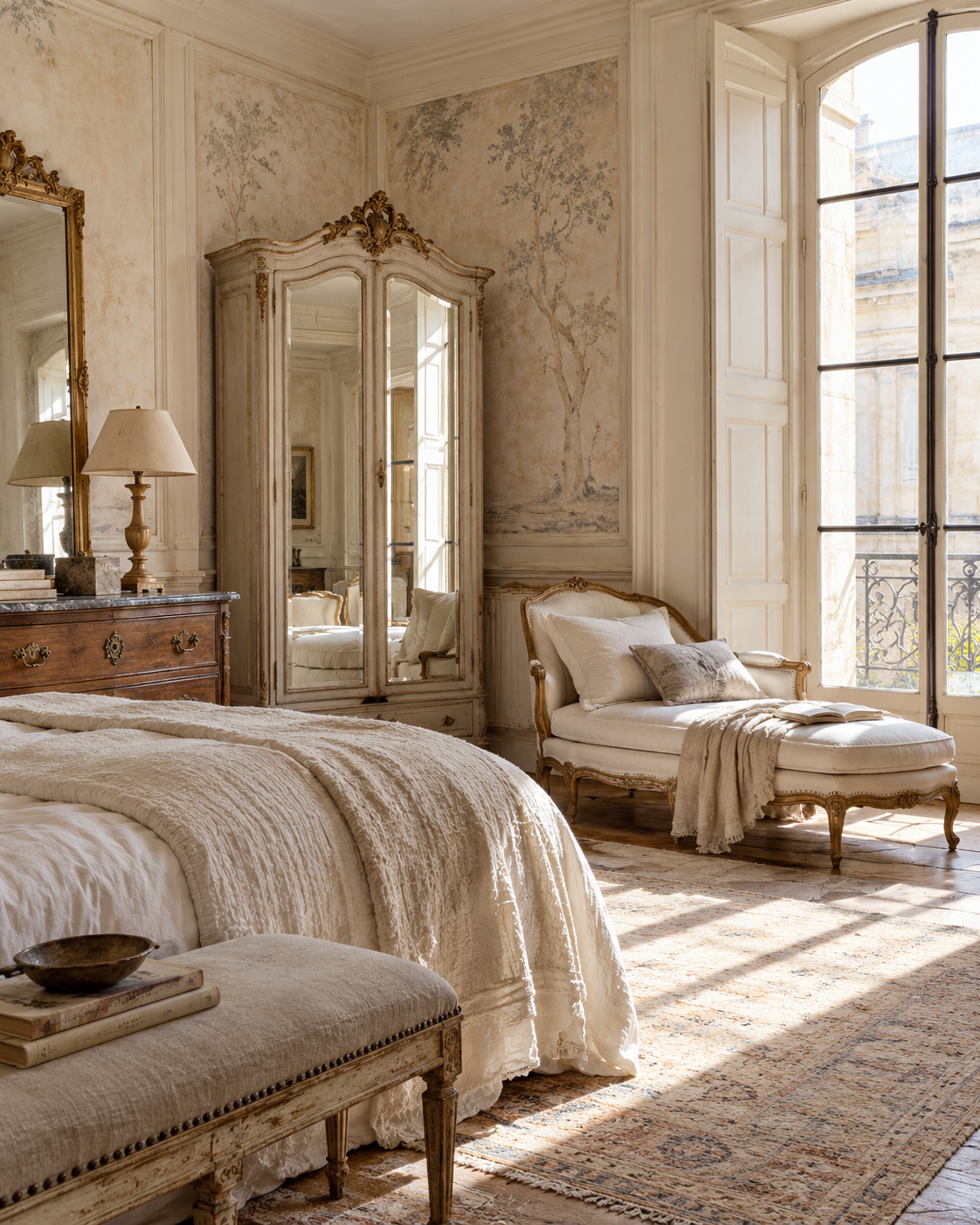
Faded grandeur does not mean beige.
In fact, softened colour can feel richer than a pristine new shade.
A wall that was once ochre.
A muted wine-coloured textile.
Blue-green metal altered by oxidation.
A timber floor changed by decades of sunlight.
These are colours that contain time.
That is also why they often sit so comfortably together.
They have already softened.
Where did the table come from?
How old is the chair?
Was the cabinet always that colour?
These questions become more meaningful when newness itself is no longer the goal.
Livingetc describes provenance as an increasingly important part of contemporary luxury – where story, discovery and origin matter as much as appearance.
Older objects therefore take on a different status.
Not as nostalgic props.
But as things with lives of their own.
At London Design Festival 2026, Livingetc described a clear shift within Mayfair Design District: luxury was increasingly defined by craft, unusual materials, visible processes and objects with stories rather than flawless finishes.
That distinction matters.
Because luxury no longer needs to mean untouched.
Quite the opposite.
An irregular seam.
A handmade surface.
Furniture showing traces of previous use.
Can communicate more than something perfectly mass-produced.
Prestaged notes: The most expensive-looking finish is not always the most polished. Sometimes it is the one that has had time to become better.
In historic homes, there can be a temptation to make everything match the building.
It is not necessary.
Older architecture often becomes more compelling when contemporary furniture is allowed to sit clearly against it.
It respects both.
House & Garden shows the same principle across some of its strongest historic interiors: the past does not need to be imitated in order to remain relevant. It can instead be met with clearly contemporary layers.
There is, in fact, an old phrase for this.
British decorator John Fowler used the expression “pleasing decay” – the idea that old and new can live together and that older things do not need to be returned to perfection in order to have a new life.
House & Garden revisited the phrase in 2026 while considering how much “lived-in” character a home can hold.
It may be the best description of faded grandeur.
Not decay.
Not shabby chic.
Not romanticised wear.
But the beauty of something that has existed long enough to become more complex.
Ultimately, faded grandeur is less about a particular style than an attitude.
Not replacing something simply because it has grown old.
Seeing marks as information.
Allowing an old piece to remain old.
Not renovating away every trace of time.
The most sophisticated room therefore does not have to be the one that looks most finished.
It may be the one that feels as though it began long before we arrived.
And will continue long after we leave.
Prestaged distinguishes between historical facts, traditional beliefs, modern interpretations and scientifically supported connections. Our features are fact-checked against academic and institutional sources. Where research is uncertain or disputed, we say so. Sources appear alongside relevant claims and are also collected below.
Selected environments, guides, longer reads and details worth saving. Curated by Prestaged.
After several years of matte surfaces, limewashed walls and natural materials, shine is returning. Lacquer, chrome, mirrors and reflective surfaces are shaping a new kind of elegance at home.
Read the guideA 1940s piano, a lamp rescued from the recycling centre and pieces given a place in a new setting. In this home, second-hand finds, inherited objects and newer interiors sit comfortably side by side.
Read the guideStucco, panelled doors and herringbone parquet already do the work. The rest is about not competing with them.
Read the guide