Deep dive
Faded Grandeur
Patina, aged materials and traces of time are shaping a new kind of luxury where old things do not need to be restored to perfection. Faded grandeur is about rooms that carry their history with pride.
Read the guideAfter several years of matte surfaces, limewashed walls and natural materials, shine is returning. Lacquer, chrome, mirrors and reflective surfaces are shaping a new kind of elegance at home.
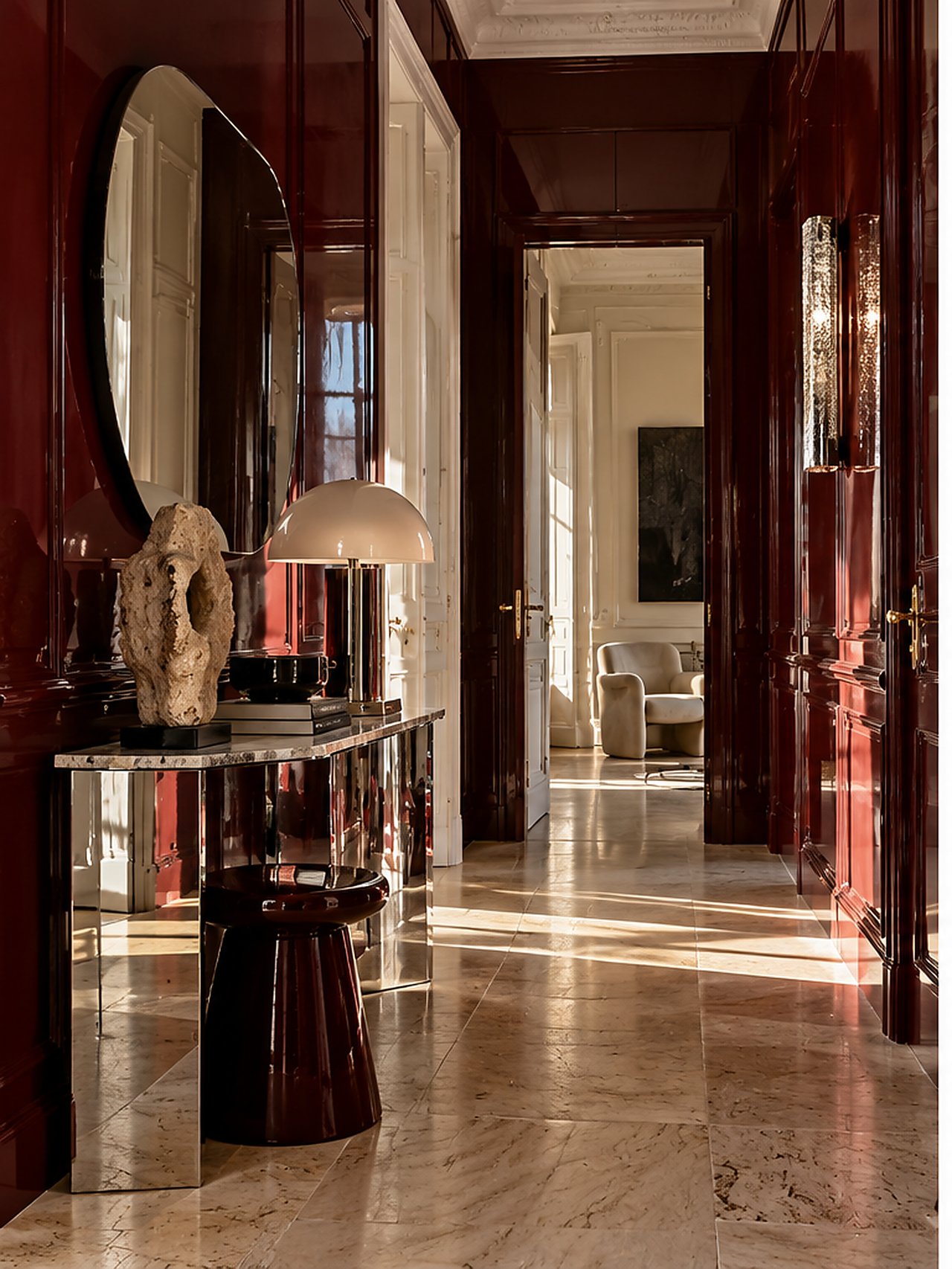
For a long time, sophisticated interiors have been almost synonymous with matte finishes.
Limewashed walls. Honed stone. Oiled timber. Rough linen. Ceramics with visible texture.
Materials that absorb light rather than reflect it.
Now something is changing.
Across design fairs, new interiors and the work of some of the most interesting designers, more surfaces are doing exactly the opposite.
They shine.
Lacquered furniture. Polished metal. Mirror. Glazed ceramics. Gloss paint. Glass that catches the room around it.
Livingetc has described high-shine finishes as one of the clearest directions to emerge from Milan Design Week 2026, with lacquer appearing on everything from tables and chairs to unexpected furniture details. ELLE Decor has likewise identified reflective surfaces – tinted mirrors, glossy paint and metallics – as a significant direction this autumn.
This is not simply a return to 1980s glamour.
It is far more controlled.
Perhaps the most interesting aspect of the new gloss is that it is almost always used in contrast.
Lacquer beside timber.
Chrome against linen.
Glossy ceramic next to raw stone.
Mirror beside something patinated.
It is the tension between materials that makes both feel more pronounced.
Livingetc points to precisely this contrast as central to lacquer's return: shine becomes more effective when paired with texture and matte surfaces, rather than when an entire room is treated in the same way.
Prestaged notes: The new gloss is less about maximalism and more about material balance. One reflective surface can be enough to change an entire room.
Lacquer has long appeared on smaller objects and decorative furniture.
Now it is moving onto larger surfaces.
Kitchen cabinetry. Wall panelling. Ceilings. Dining tables. Shelving. Doors.
Architectural Digest recently highlighted the return of statement lacquer in the work of designers including Athena Calderone and Mark Grattan, where entire architectural elements are treated in high gloss rather than simply individual pieces of furniture.
It gives colour greater depth.
A dark red wall in matte paint can feel heavy.
The same colour in lacquer shifts according to light, movement and time of day.
The surface becomes a material in its own right.
This is also where mirror and metal come in.
Mirror was once primarily decorative – placed above a console, framed on a wall or used as a standalone object.
Now reflection is increasingly architectural.
A mirrored wall can extend a room.
Chrome can almost dissolve into its surroundings.
A glossy surface can pull light into a darker part of a space.
ELLE Decor describes reflective materials as a way of manipulating light and creating architectural interest rather than simply adding decoration.
This may be lacquer's greatest strength.
It makes colour feel more intense without requiring the colour itself to become brighter.
A dark olive can appear almost black in shadow and suddenly turn emerald in reflection.
Burgundy can move between brown, wine and near-black.
Pale blue can feel cool one moment and warmer the next.
Even restrained colours begin to move.
Livingetc noted the same development in Milan: lacquer remained prominent, but appeared in softer shades including warm browns, mint, olive green, pale blue and muted neutrals.
That distinction matters.
Gloss does not have to shout.
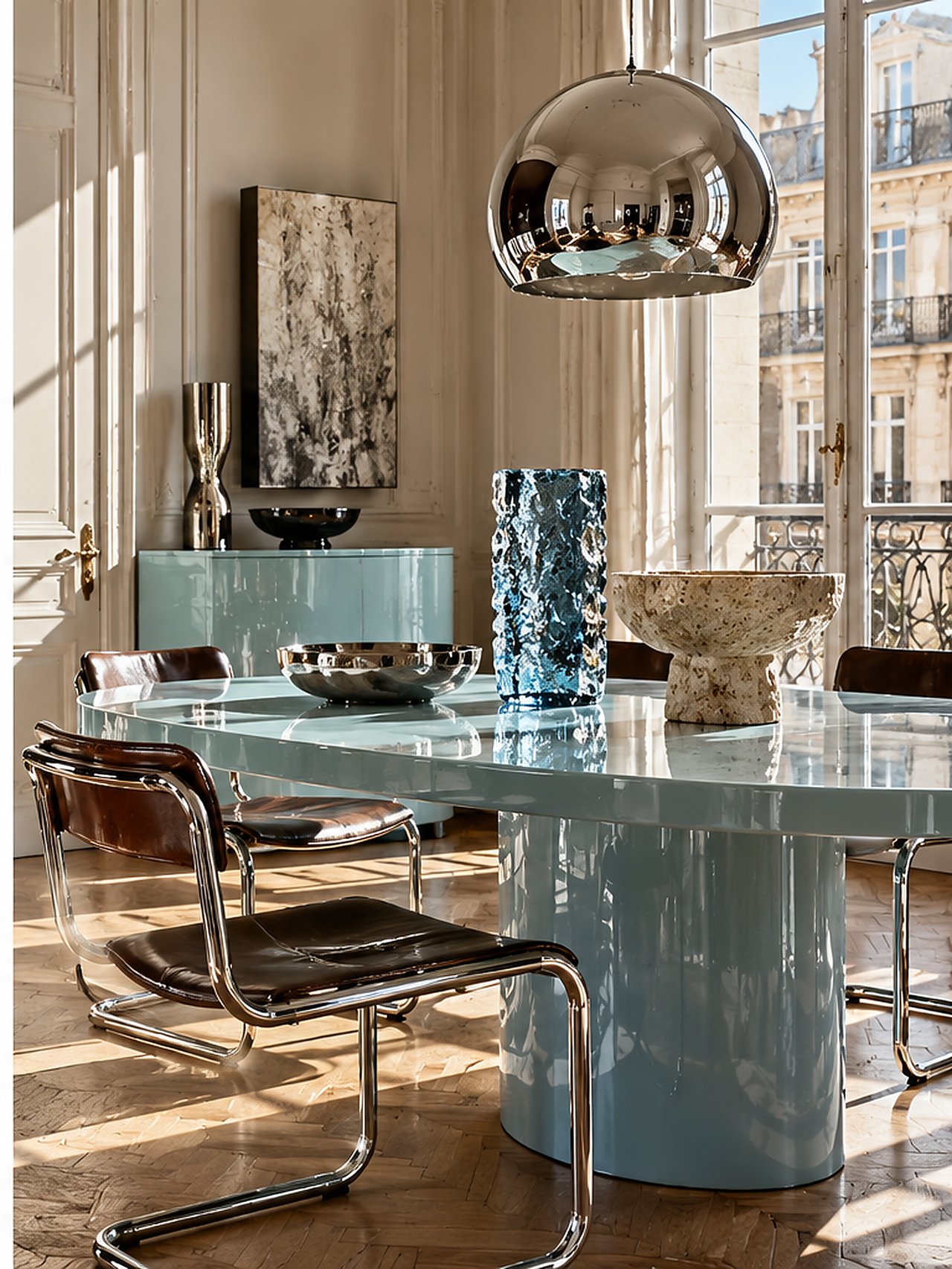
Chrome has changed role too.
A few years ago it could feel futuristic or industrial.
Now it is increasingly used almost as a neutral accent.
A lamp. A side table. A fitting. A bowl.
Glassette describes the same shift in 2026, with chrome returning in a softer, more decorative form and working particularly well beside dark timber, tactile upholstery and matte surfaces.
That may be precisely why the material feels relevant again.
It does not necessarily dominate.
It simply picks up what is already in the room.
It is easy to associate high-shine surfaces with glamour.
But some of the most interesting examples now appear in interiors that are otherwise relatively restrained.
A single glossy cabinet in a calm kitchen.
A chrome lamp against a plaster wall.
A lacquered table on an old timber floor.
That is where the material feels most contemporary.
Not when everything tries to shine.
But when one surface does.
Prestaged notes: The most elegant use of gloss is often to let one reflective surface sit within a room that is otherwise quiet.
There is also something interesting about the nature of the surface itself.
High gloss reveals almost everything.
Fingerprints. Imperfections. Light. The architecture around it.
Livingetc has recently highlighted high-gloss ceilings as a new development of colour drenching precisely because they introduce greater reflection and depth – while also exposing every irregularity beneath the finish.
It is not an effortless material.
Perhaps that is part of its appeal.
The surface lives.
This is where the new gloss feels most Prestaged.
Not in a room where everything is new.
But where reflection meets something with history.
Chrome beside antique timber.
Lacquer against old stone.
Glazed ceramic on a worn table.
Mirror inside a classical room.
The result is less about a particular style and more about tension.
That is also why glossy interiors feel different now.
They are not about choosing a shiny aesthetic.
They are about using reflection as one material among many.
Matte finishes are not disappearing.
Nor should they.
In fact, it may be precisely because we have spent years surrounded by limewash, wool, timber and natural stone that reflective surfaces feel interesting again.
We have become accustomed to materials that absorb light.
Now we also want something that sends it back.
A lacquered piece.
A mirror.
A chrome object.
A glazed surface.
Not everywhere.
Just enough for the room to change as you move through it.
Prestaged distinguishes between historical facts, traditional beliefs, modern interpretations and scientifically supported connections. Our features are fact-checked against academic and institutional sources. Where research is uncertain or disputed, we say so. Sources appear alongside relevant claims and are also collected below.
Selected environments, guides, longer reads and details worth saving. Curated by Prestaged.
Patina, aged materials and traces of time are shaping a new kind of luxury where old things do not need to be restored to perfection. Faded grandeur is about rooms that carry their history with pride.
Read the guideThe salon is back – not as a formal alternative to the living room, but as a home built around conversation, music, books, dinners and people who actually stay.
Read the guideDurable, honest and finished with a soft matt sheen that ages well. How to avoid the professional-kitchen look.
Read the guide