Deep dive
The Collectible Home
The line between design, art and craft is becoming less clear. In the collected home, objects are not there to fill surfaces but to carry ideas, materials and stories.
Read the guideThe salon is back – not as a formal alternative to the living room, but as a home built around conversation, music, books, dinners and people who actually stay.
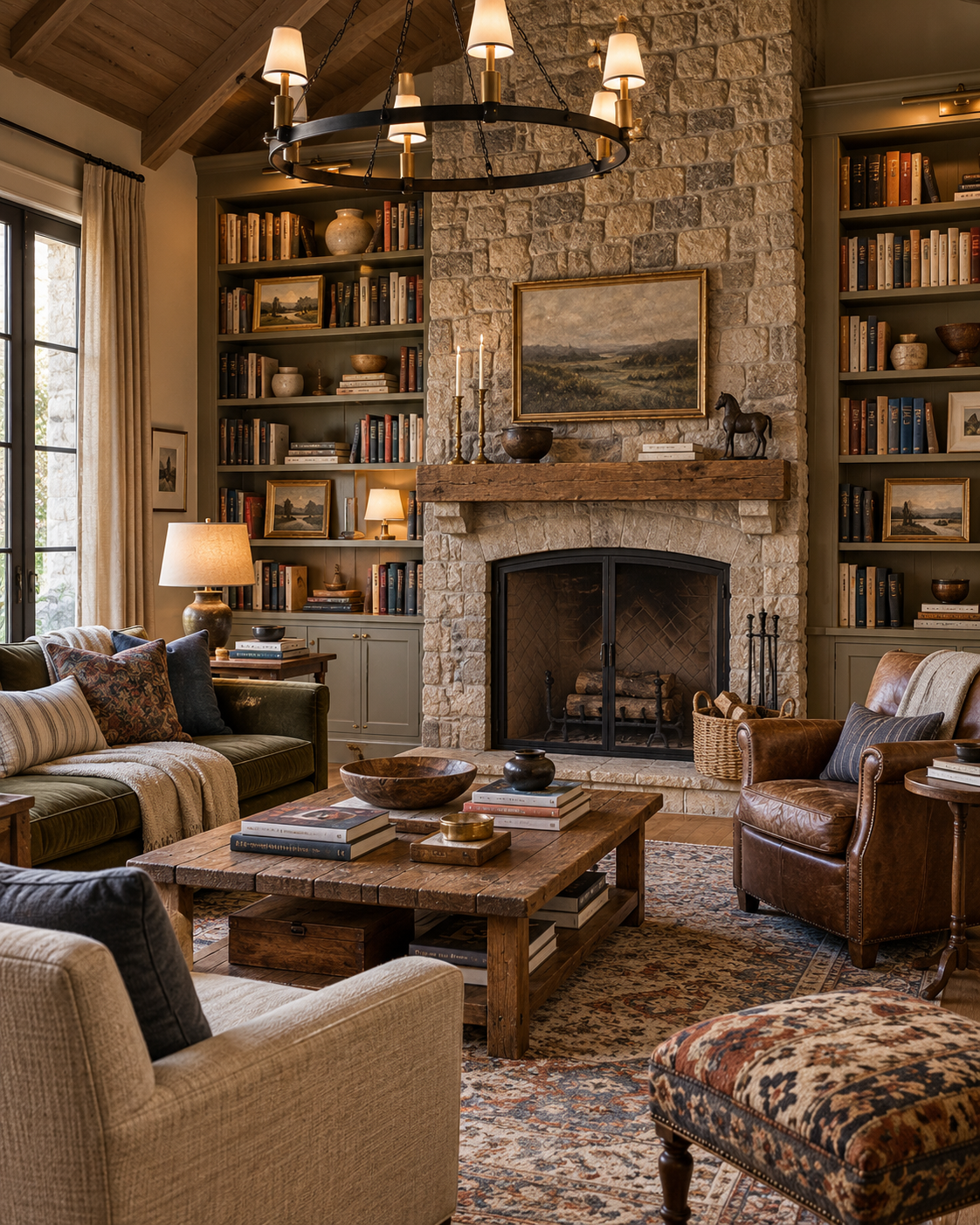
There is a difference between a living room and a room that genuinely draws people in.
The latter does not have to be larger, more expensive or more spectacular. But the furniture tends to sit differently. There is somewhere to put down a drink. Chairs face one another rather than simply facing a screen, while books, music, lighting and objects make the room feel as though something might actually happen there.
Perhaps that is why the word salon feels relevant again.
Not as a literal return to the nineteenth-century drawing room, but as a way of thinking about the home as a social and cultural place.
Architectural Digest has identified precisely this as a significant entertaining direction for 2026: longer sofas, banquettes, several seating areas and rooms designed for conversation and mingling rather than a single static arrangement.
Many living rooms direct everything towards one focal point.
The television. The fireplace. The window.
A social room needs more relationships between the furniture.
Two chairs angled towards a sofa can do more for conversation than another oversized coffee table. A small table between two armchairs can create a room within a room, while a bench or chaise can open a seating arrangement in several directions.
The same idea can be seen across many of this year's more compelling interiors: several smaller zones rather than one perfect composition.
House & Garden has highlighted how expansive open-plan spaces are increasingly being divided into more intimate, cohesive areas suited to both family life and entertaining.
Prestaged notes: A social room rarely begins with more furniture. It begins with allowing the furniture already there to speak to one another.
Books change a room.
Not only visually.
They suggest that you are allowed to stay.
A bookcase, a stack of books on a side table or a low cabinet filled with things that are genuinely used gives a room more life than perfectly empty surfaces.
House & Garden is currently noting greater demand for highly personal rooms devoted to real interests – reading, music, film and other pastimes – rather than generic multipurpose spaces.
You do not need a dedicated library.
Three shelves may be enough.
A record player.
A piano.
Speakers that do not have to be hidden.
A collection of records.
Music can be part of an interior in exactly the same way as books and art.
It also changes the behaviour of the room. A television tends to pull attention in one direction. Music can fill the entire space without requiring anyone to look at anything.
It is a small distinction, but socially a significant one.
Another clear signal is the home bar.
House & Garden identified several full-scale bars at WOW!house 2026 and singled out the dedicated home bar as one of the year's strongest entertaining ideas. Studio Duggan's Speakeasy Salon also concealed an intimate bar within the room, reinforcing its club-like atmosphere of conversation and escape.
Of course, there is no need to build one.
A tray.
A small cabinet.
A few glasses.
A carafe.
That can communicate the same idea: there is something here for the guest.
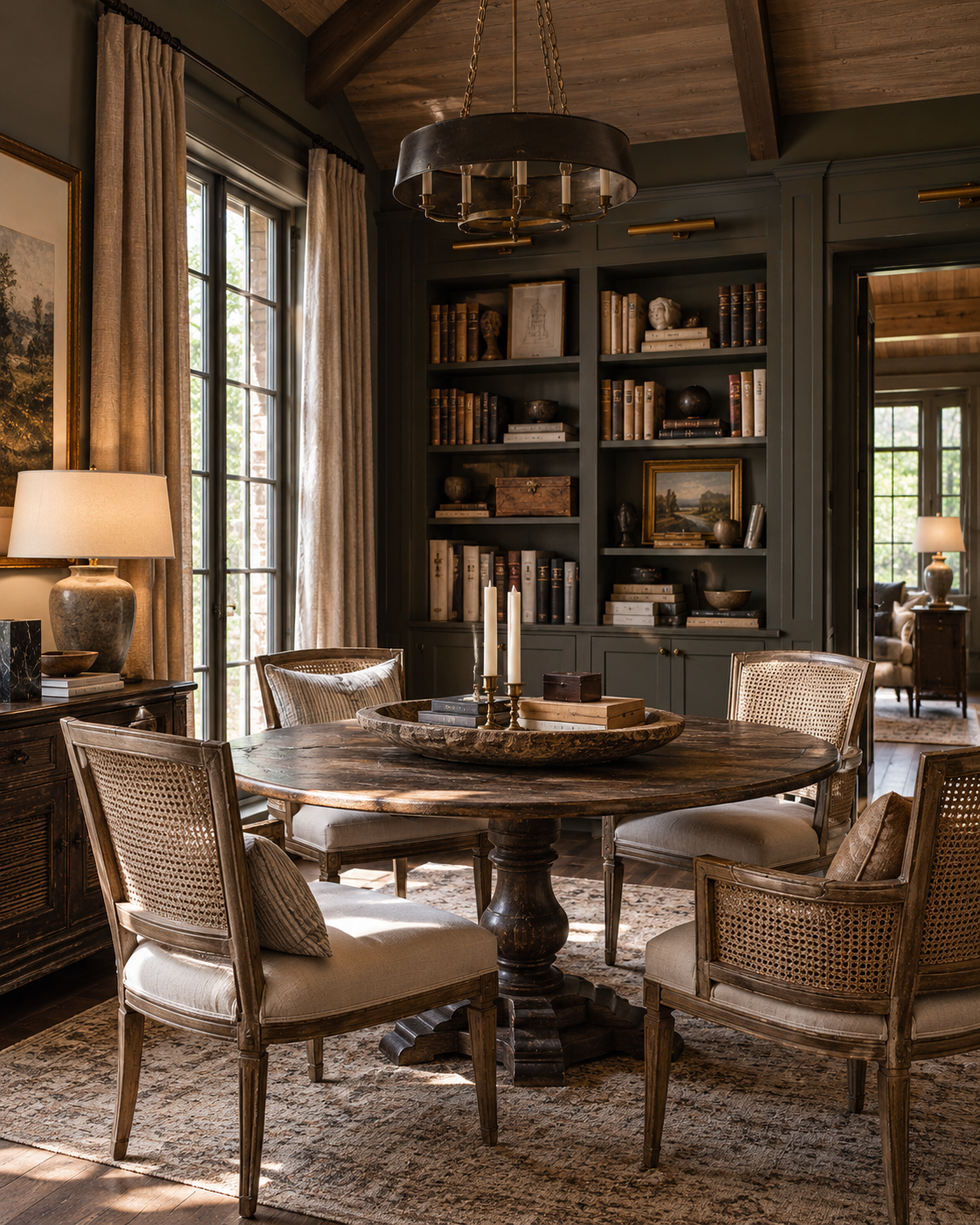
This may be the biggest difference from the conventional living room.
The salon does not end where the sofa ends.
The dining table can belong to the same social world.
In its 2026 interiors coverage, Vogue describes the dining chair as emblematic of a more lived-in home, sitting at the centre of dinner, conversation, work and everyday rituals. It is precisely those repeated activities that make a home feel inhabited rather than styled.
The dining table therefore does not need to stand as an isolated zone.
Books can sit there.
A lamp can glow from a nearby sideboard.
One chair can be more beautiful than the others.
The piano might stand two metres away.
It is the whole composition that makes the room.
There is something liberating about this shift too.
A dinner does not need to begin with the entire home looking finished.
Throughout the year, Vogue has featured a looser style of entertaining in which the reason for gathering can be modest and atmosphere matters more than perfection. Its Aperitivo Hour series has also celebrated dinners without rigid schedules, fixed guest lists or heavily prescribed menus.
That sits comfortably with the salon idea.
The home is the setting.
But the evening matters more than the setting.
Prestaged notes: A room does not become social because it is perfectly prepared. It becomes social because it is easy to use.
Lighting is crucial in a social room.
Not necessarily bright lighting.
Quite the opposite.
Table lamps, floor lamps and wall lights create smaller zones that can coexist within the same room.
One person reads.
Two people talk at a small table.
Someone else sits further away.
House & Garden's WOW!house coverage shows exactly this approach in its 2026 salon rooms, where layered lighting, material richness and smaller moments within the larger room create a theatrical but intimate atmosphere.
The word salon can sound pretentious.
The idea itself is quite simple.
A home where people read.
Listen.
Talk.
Eat.
Show art.
Pull a book from a shelf.
Put on a record.
Invite someone in.
It is closer to everyday life than ceremony.
Perhaps that is exactly why this kind of room feels relevant again.
House & Garden's November 2026 Culture Issue explicitly centres on art-filled homes and people shaping cultural conversations – another indication that the home is once again being treated as more than a backdrop for aesthetics.
There does not need to be a room labelled “salon” on the floor plan.
It can be the living room.
The dining room.
The library.
Or the space between them.
What matters is what the room encourages people to do.
If everything faces a screen, it becomes a room for watching.
If the chairs face one another, books are within reach, music can be played and there is somewhere to place a glass or plate, something changes.
The room begins to work for conversation.
And perhaps that is one of the most interesting forms of luxury right now.
Not a home that is merely beautiful to look at.
But one you actually want to stay in.
Prestaged distinguishes between historical facts, traditional beliefs, modern interpretations and scientifically supported connections. Our features are fact-checked against academic and institutional sources. Where research is uncertain or disputed, we say so. Sources appear alongside relevant claims and are also collected below.
Selected environments, guides, longer reads and details worth saving. Curated by Prestaged.
The line between design, art and craft is becoming less clear. In the collected home, objects are not there to fill surfaces but to carry ideas, materials and stories.
Read the guideThe most interesting interiors right now are not the most perfect ones. They contain something strange, personal or unexpected – a reaction to years of algorithm-friendly interiors that have started to look the same.
Read the guideSeating, lighting and a correctly sized rug matter more than colour. How to plan a living room that works all week.
Read the guide