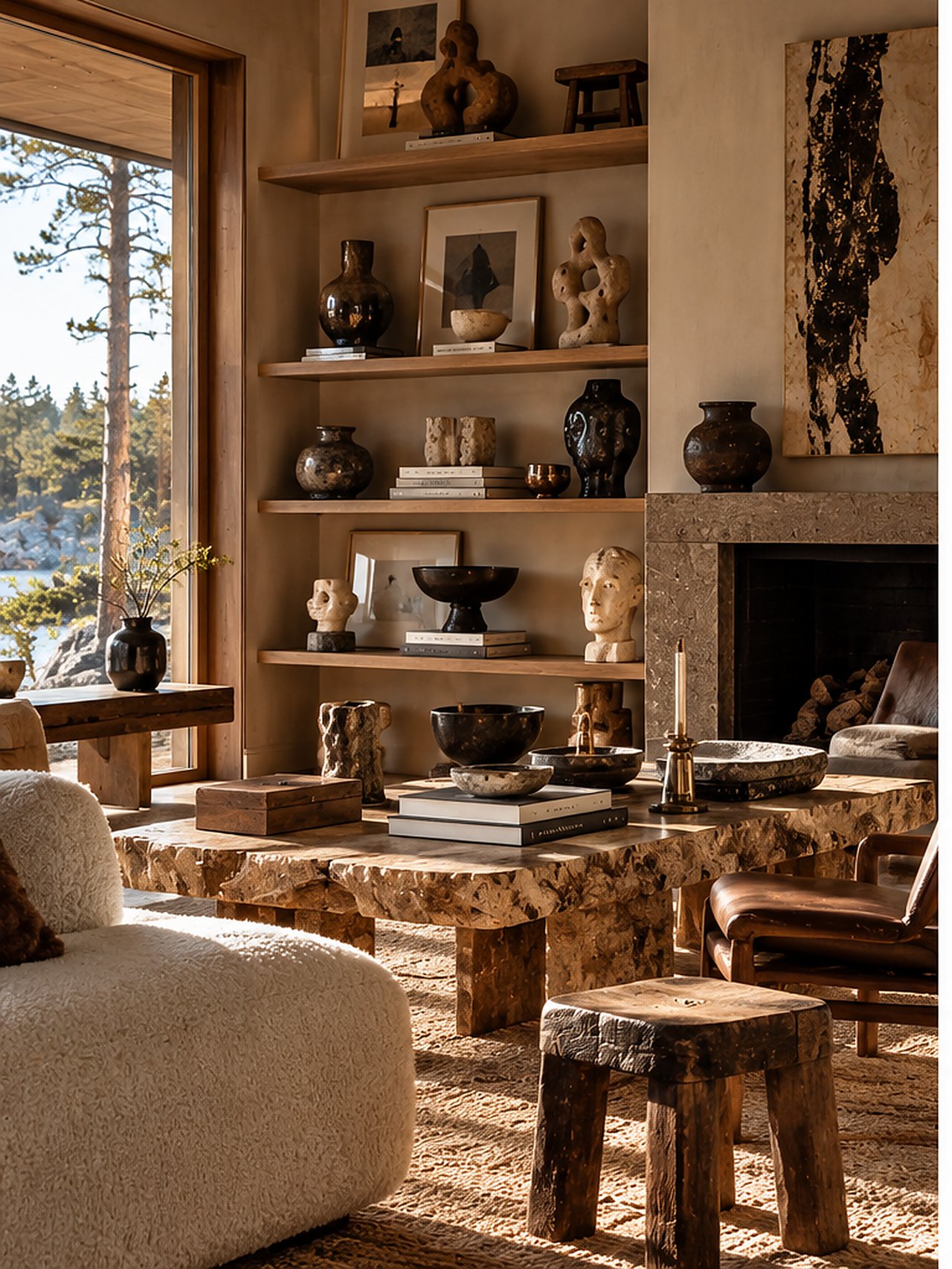
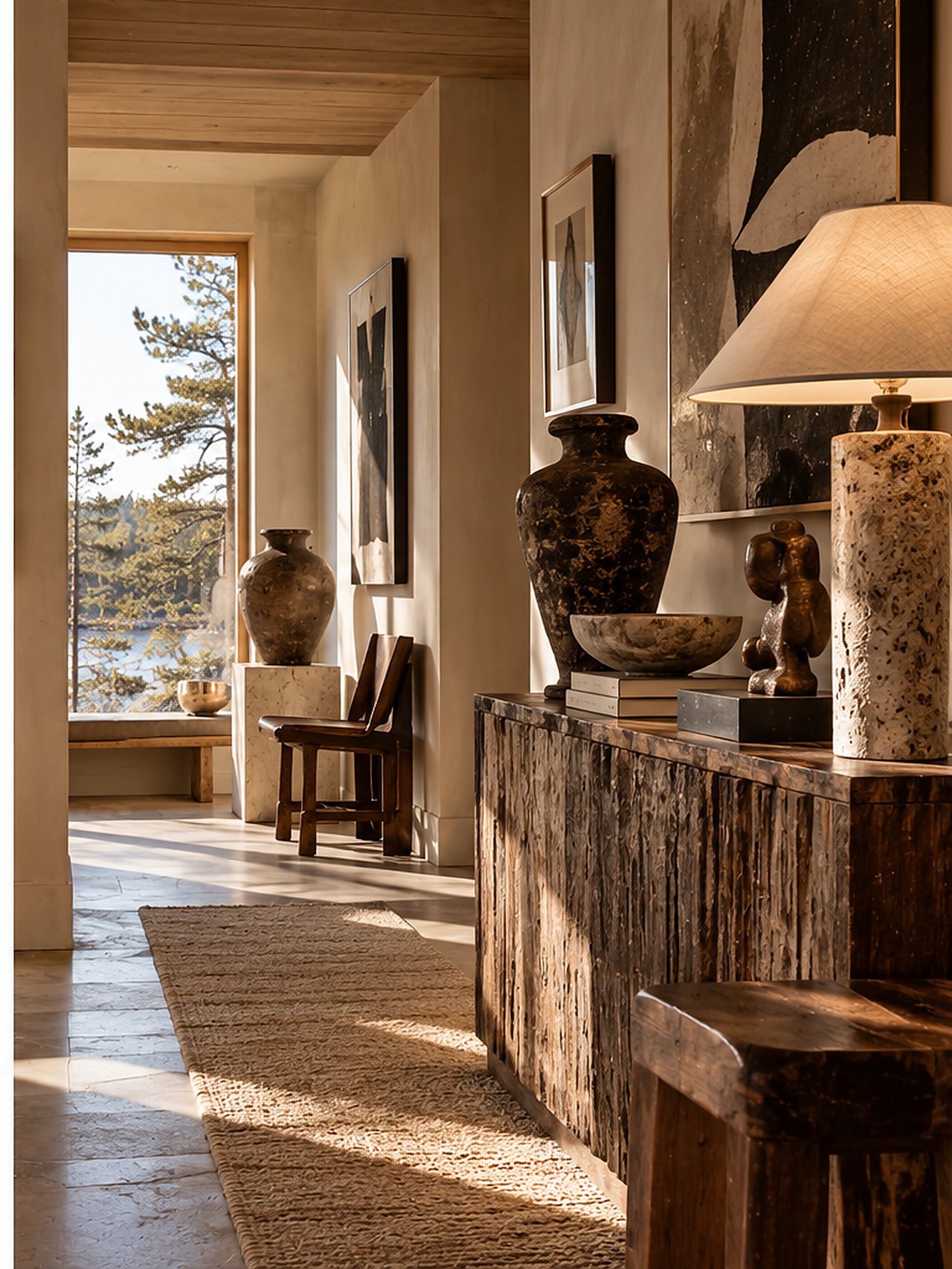
The line between design, art and craft is becoming less clear. In the collected home, objects are not there to fill surfaces but to carry ideas, materials and stories.
IMAGE: PRESTAGED
There are homes where everything looks good.
And then there are homes where you remember one particular thing long afterwards.
A chair that almost resembles sculpture.
An unusual lamp.
A table with a surface you want to touch.
A ceramic form that does not really serve any obvious purpose at all.
That is often where a room begins to feel collected rather than simply decorated.
At the same time, the line between art and design continues to blur. At Frieze London 2026, Wallpaper highlighted pieces in which furniture clearly moves towards functional art: chairs, benches and cabinets where material, concept and artistic expression matter at least as much as use.
Design Miami similarly describes collectible design as a field in which historic and contemporary works sit alongside one another – from furniture and lighting to objects occupying the space between art, craft and function.
But a collectible home does not need to mean a home filled with expensive design.
Quite the opposite.
It is about seeing certain things as more than filler.
An object does not need to explain itself
There is a clear difference between decoration and an object with presence.
Decoration can fill an empty surface.
A genuinely strong object can almost create its own space around it.
It does not need to match the sofa.
It does not need to belong to a set.
It does not even need to be immediately beautiful.
It might be a ceramic sculpture. A side table with an unexpected shape. A handmade chair. An old vessel. A small bronze form. A lamp that almost behaves like architecture.
What they share is the ability to stand on their own.
Prestaged notes: A strong object does not need to fill the room. It simply needs enough space to be noticed.
Fewer things can create more character
A collected home is not necessarily about collecting a lot.
Objects often become stronger when they are given more room.
A single sculpture on a low plinth can be more effective than an entire still life.
A chair with an unusual silhouette can carry greater weight when it is not surrounded by five other statement pieces.
An object on an open shelf can almost function as art.
This is a different logic from conventional styling, where every surface is expected to feel filled and balanced.
Here, emptiness does some of the work too.
Function meets art
Collectible design is compelling precisely because it often exists between the two.
An object can be useful – while still being expressive enough for its function to become almost secondary.
Wallpaper*'s report from Frieze London 2026 captures that movement, from sculptural chairs and raw stone paired with timber to ceramic benches and pieces built around distinct narratives.
It is equally telling that Design Miami describes its galleries as presenting “museum-quality furniture, lighting and objets d’art” – design treated with the same attention as art.
That changes how we look at the home.
A chair does not have to be just a chair.
A table can also be a composition.
A collection does not have to be expensive
It is easy to assume collectible design begins at an auction house or design fair.
But the interesting part is the eye itself.
An object from a flea market can be stronger than an expensive designer piece if its form, material or history is compelling enough.
It might be:
an old glass object an unusual wooden bowl handmade ceramics a small sculpture a side table with patina an eccentric lighting piece a chair by an unknown designer
The value does not need to be financial.
Visual value can be enough.
Let things carry a story
What makes a collected home interesting is rarely form alone.
It is the story.
Where did the object come from?
Who made it?
Why is it here?
Design Miami 2026 places considerable emphasis on material, craft, cultural memory and the way objects can carry stories over time. This year's programme includes projects where craftsmanship, memory and materiality are explicit themes.
The same is true at home.
An object you know something about often has greater presence than one purchased simply to fill a space.
The plinth is back
There is something almost museum-like about the way more interiors are giving individual objects their own scenography.
Plinths.
Small tables.
Dedicated shelves.
Niches.
Empty space around a single piece.
It does not have to feel pretentious.
A low stone block holding one simple object can create more calm than a fully styled bookcase.
The trick is to let one thing matter.
Prestaged notes: You do not need to turn your home into a gallery. But you can borrow the gallery's best idea: everything does not need to sit close together.
Mix high and low
A collectible home becomes interesting when it is not too correct.
A contemporary sculpture beside an old timber table.
A flea-market vase beneath an expensive artwork.
A design object next to a book you have owned for twenty years.
It is often the mixture that removes the showroom feeling.
And this is where the Prestaged aesthetic becomes strongest.
Not through choosing one single level.
But through combining them.
Furniture can become the protagonist
We are used to thinking of furniture as the background to a room.
But some pieces are strong enough to carry the entire space.
A chair with a dramatic silhouette.
A table made from solid stone.
A cabinet with an unusual proportion.
A hand-built bench.
At Frieze London, these kinds of works are increasingly visible in the space between art and design, with functional pieces presented almost as sculpture.
That does not mean every piece needs to make a statement.
One is often enough.
Collect over time, not over a weekend
A collected home is almost impossible to create quickly.
Perhaps that is precisely its appeal.
A room built slowly tends to develop more layers.
Something from a journey.
Another thing from a flea market.
Something inherited.
Something new by a young designer.
Something you saved for.
When everything does not come from the same shopping trip, the catalogue feeling disappears too.
When objects become more than products
Ultimately, The Collectible Home is about how we look at things.
Not as products intended to fill a room.
But as objects capable of carrying an idea, a material, a story or a memory.
That is also why the boundaries between design, art and craft feel increasingly irrelevant.
The interesting question is not always what something is called.
It is what it does to the room.
The most personal home does not need the greatest number of objects.
Only a few worth stopping for.
How Prestaged works with facts
Prestaged distinguishes between historical facts, traditional beliefs, modern interpretations and scientifically supported connections. Our features are fact-checked against academic and institutional sources. Where research is uncertain or disputed, we say so. Sources appear alongside relevant claims and are also collected below.
Newsletter
Prestaged Edit
Selected environments, guides, longer reads and details worth saving. Curated by Prestaged.
The most interesting interiors right now are not the most perfect ones. They contain something strange, personal or unexpected – a reaction to years of algorithm-friendly interiors that have started to look the same.
The salon is back – not as a formal alternative to the living room, but as a home built around conversation, music, books, dinners and people who actually stay.
A 1940s piano, a lamp rescued from the recycling centre and pieces given a place in a new setting. In this home, second-hand finds, inherited objects and newer interiors sit comfortably side by side.