Deep dive
The Collectible Home
The line between design, art and craft is becoming less clear. In the collected home, objects are not there to fill surfaces but to carry ideas, materials and stories.
Read the guideThe most interesting interiors right now are not the most perfect ones. They contain something strange, personal or unexpected – a reaction to years of algorithm-friendly interiors that have started to look the same.
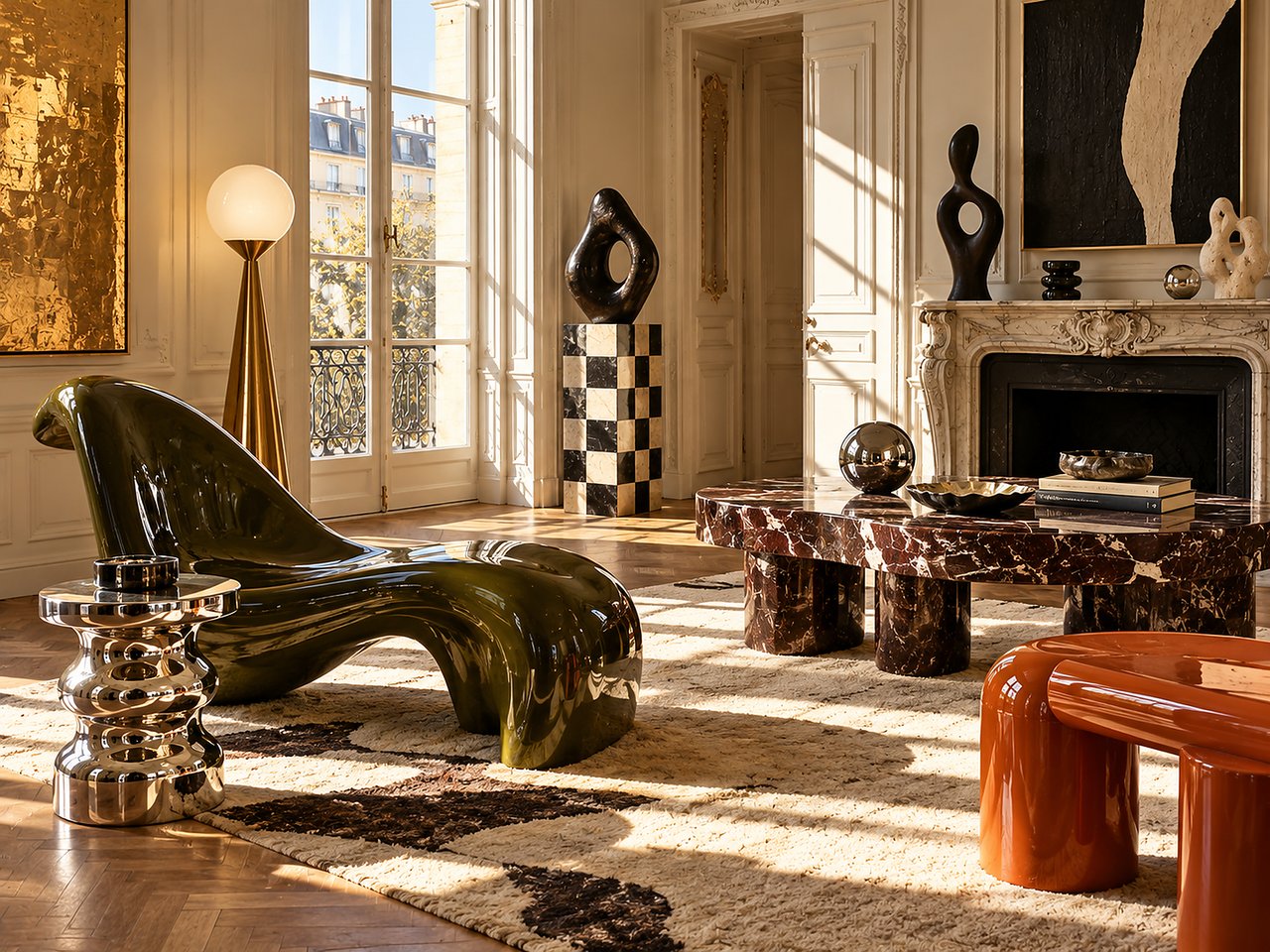
There is a particular kind of room that has been easy to recognise over the past few years.
The right sofa. The right stone. The right lighting. A handful of design objects that signal taste without disrupting the whole.
Calm, sophisticated and perfectly photogenic.
The problem is that more and more of these rooms have also started to look alike.
When inspiration comes from the same feeds, the same saved images and the same references, taste naturally begins to drift towards a shared middle ground.
Now something else is happening.
The rooms that feel most interesting are not necessarily the most perfect. There is often something slightly awkward in them. An object you did not expect. A colour combination that should not quite work. An inherited table beside a new chair. A strange sculpture that would never have been selected simply to complete a moodboard.
And that is precisely why they feel more alive.
Architectural Digest recently described the same shift as “good taste is getting weirder”: as design becomes easier to search, shop and replicate, traditional markers of taste lose some of their authority. Personal references, humour, memory and unexpected combinations begin to matter more.
The strange object was once something to tone down.
Now it can be the exact opposite.
An unusual vase, an oversized artwork, an inherited desk, a souvenir from a journey or a chair with a shape that feels slightly too much can become the thing that gives an entire room its identity.
The point is not that the object is expensive or “correct”.
The point is that it feels specific.
That is also what makes this kind of interior harder to copy. You can buy the same sofa or lamp, but not the same memories, references or point of view.
Prestaged notes: Personality cannot be styled in by adding one “quirky” object at the end. There needs to be a reason for it to be there.
A well-designed home has long been associated with consistency: a controlled palette, compatible woods, coherent periods and a recognisable style.
Some of the most compelling interiors now do almost the opposite.
A sharply modern table can sit beneath an old painting. Polished metal can meet worn timber. A sculptural piece of furniture can occupy a highly classical room.
Vogue has also highlighted a wider move towards layered, lived-in interiors where personality and material richness matter more than sterile perfection.
It is a surprisingly liberating idea.
A home does not need to look as though everything was chosen at the same time.
The easier it becomes to create perfect images and perfect environments, the more appealing the difficult-to-reproduce becomes.
Hand-blown glass. Marks in wood. Ceramics where the maker's hand remains visible. Metal with patina. A table made more beautiful through use.
Vogue points to the same appetite for tactile materials, craftsmanship and interiors that carry clearer traces of life and time.
The same applies to older pieces.
Patina no longer needs to be hidden.
It can be the entire point.
A sophisticated interior does not have to be completely serious.
Increasingly, we are seeing objects with exaggerated proportions, surreal forms and a clearer sense of humour.
That does not mean everything has to be strange.
One detail can be enough.
A chair that almost reads as sculpture. A lamp that feels slightly too large. An object that makes you look twice.
It is often that friction that makes a room memorable.
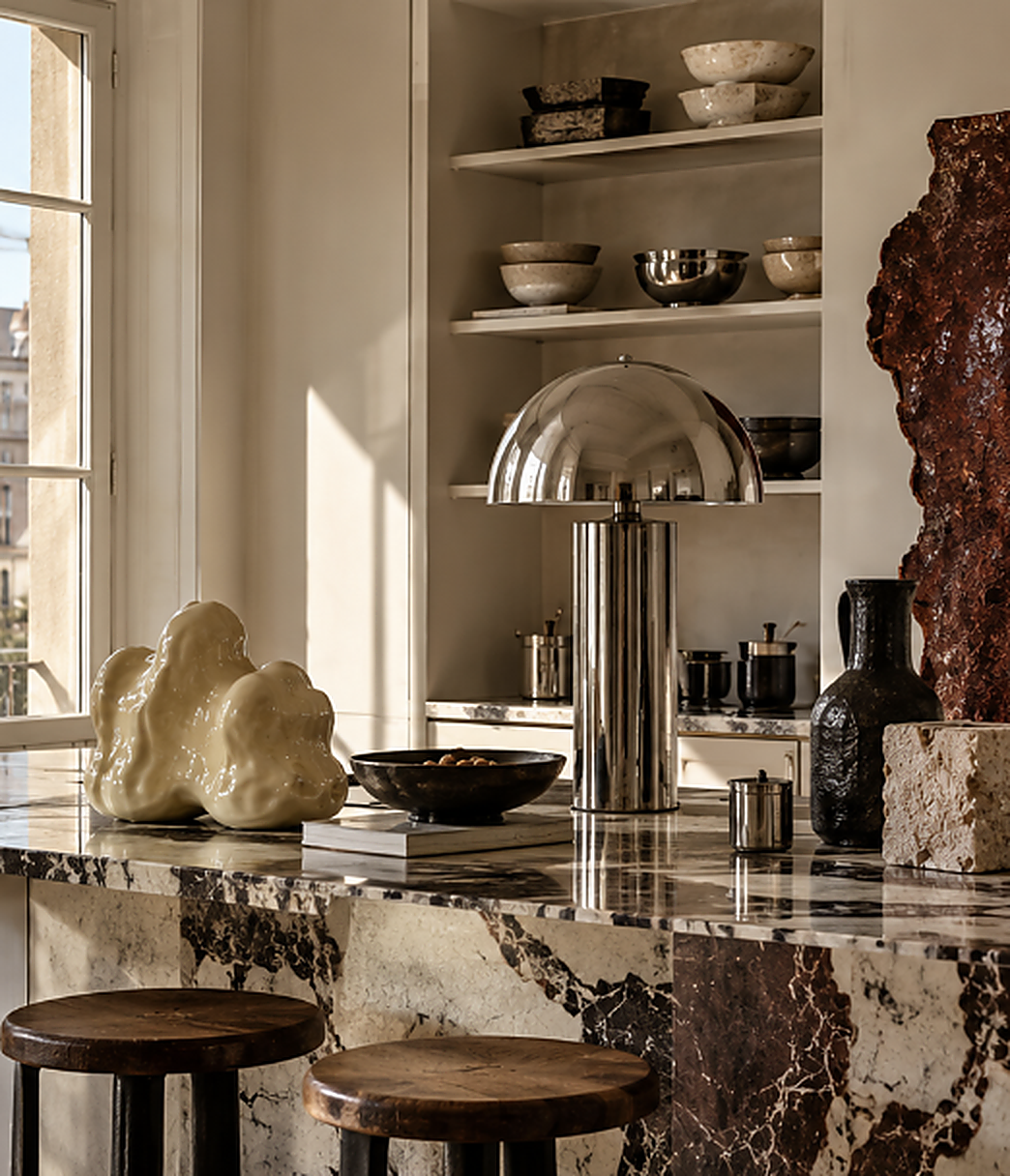
Perhaps the most interesting part of this movement is that it brings something private back into the interior.
An object can be aesthetically questionable yet emotionally irreplaceable.
A table inherited from a parent. A small sculpture bought while travelling. Something that has always been in the family. A piece of art purchased before you even knew what your “style” was.
These things complicate a room.
But that is also exactly what can make it feel real.
Architectural Digest makes an important distinction here: this more idiosyncratic idea of taste is not about randomness, but about objects with context, history and personal meaning.
A freer definition of good taste does not mean that everything works together.
The strongest rooms still have an idea.
Proportion, materials, colour and balance still matter.
The difference is that personality is allowed to outweigh the rules.
An object can break with the rest of the room and still feel completely right.
That tension is often what makes you look again.
Prestaged notes: A room does not need to be perfectly coherent. But it should feel chosen.
Ultimately, this is about more than a trend.
When almost every source of inspiration can be searched, saved and bought, a personal point of view becomes more valuable.
Architectural Digest argues that traditional markers of good taste become less powerful when the same objects and references appear everywhere. What is harder to copy is the perspective behind the choices.
That is a fairly significant shift.
And perhaps a healthy one.
A more personal home offers fewer universal signals of what is “right”.
It becomes harder to point to a particular sofa, material or palette and declare it the sophisticated choice.
Taste becomes more dependent on the relationship between things.
Why is that particular chair there?
Why is the artwork too large?
Why was the old table kept?
Why does the unexpected object work in an otherwise restrained room?
That is where the home begins to feel like more than the sum of its products.
And perhaps that is where the next phase of interiors begins.
Not with another perfect style.
But with a clearer personality.
Prestaged distinguishes between historical facts, traditional beliefs, modern interpretations and scientifically supported connections. Our features are fact-checked against academic and institutional sources. Where research is uncertain or disputed, we say so. Sources appear alongside relevant claims and are also collected below.
Selected environments, guides, longer reads and details worth saving. Curated by Prestaged.
The line between design, art and craft is becoming less clear. In the collected home, objects are not there to fill surfaces but to carry ideas, materials and stories.
Read the guidePatina, aged materials and traces of time are shaping a new kind of luxury where old things do not need to be restored to perfection. Faded grandeur is about rooms that carry their history with pride.
Read the guideInherited pieces, finds and new purchases in the same room. What holds it together is rarely the style — it is the palette.
Read the guide