Colour & materials
Linen & natural textiles
Textiles soften sound, filter light and make a room feel finished. Linen, wool and bouclé in practice.
Read the guideWhen the line between indoors and out begins to disappear, it becomes less about garden furniture — and more about architecture, proportion and atmosphere.
A considered outdoor space does not begin with the sofa. It begins with the same questions as a good living room: where do we want to sit, how do we move through the space, where does the light fall and which material should lead?
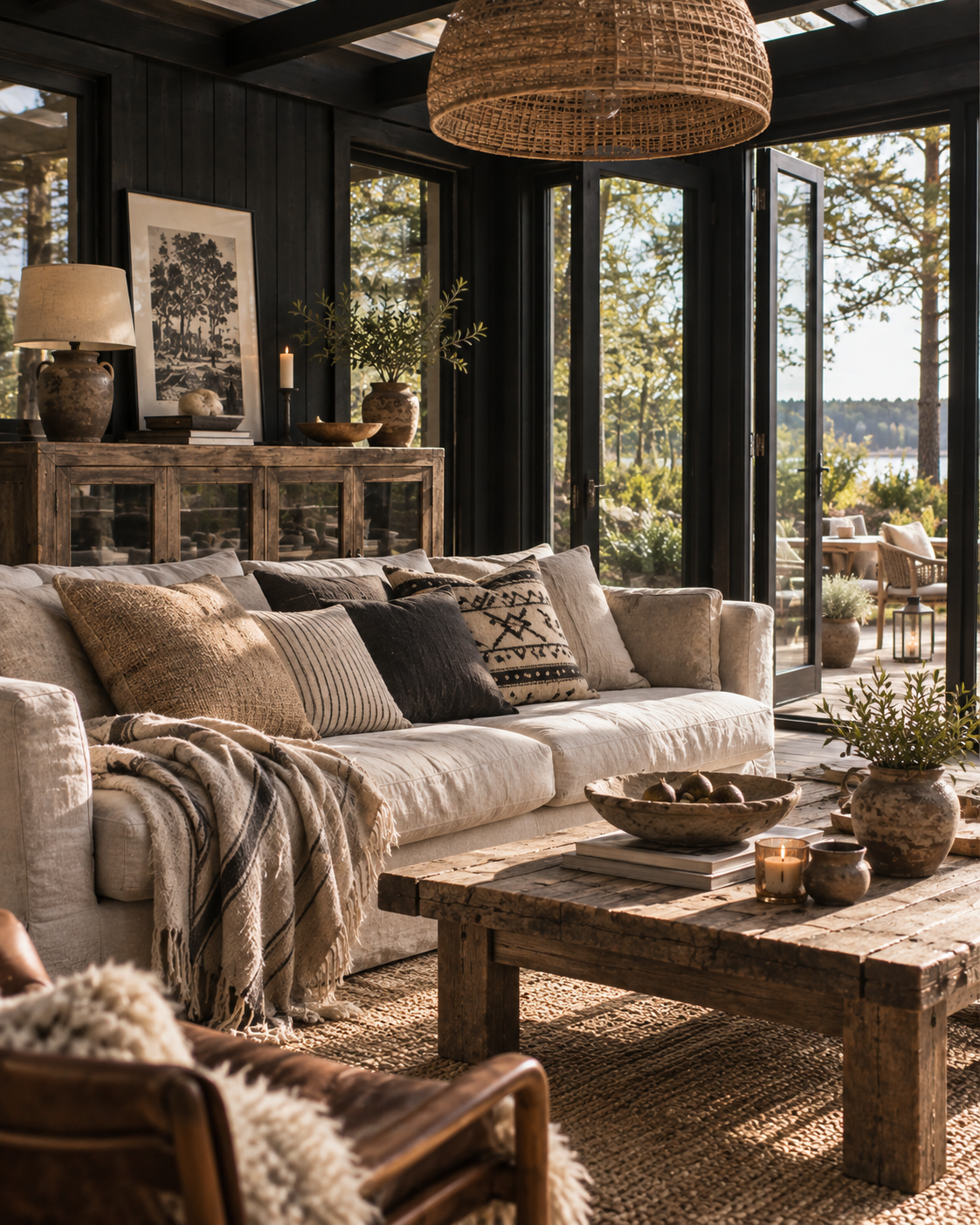
The outdoor space has long been treated as something separate from the rest of the home.
A set of furniture goes out in spring. A few pots arrive. A parasol once the sun gets too strong. And then we hope the whole will somehow come together on its own.
The most considered outdoor spaces work differently.
They are planned more as rooms than as surfaces.
That does not mean the outdoors should try to imitate a living room. Quite the opposite. It means giving the same care to proportion, movement, light, material and function.
Internationally, the shift is clear. In Houzz's 2026 U.S. Outdoor Trends Study, 83 per cent of renovated outdoor areas included a lounge or seating zone. 55 per cent had a dining area and 53 per cent a dedicated spot for quiet or reading.
Maison&Objet, meanwhile, gave Outdoor Living a prominent space of its own in 2026, with around 50 international brands across furniture, pergolas, lighting, rugs and accessories.
None of this tells us exactly what Swedish outdoor spaces look like.
But it does point to a broader design direction:
the outdoor space is increasingly treated as part of the home.
Most people begin with what they want to buy.
A sofa.
A dining table.
Two lounge chairs.
Start instead with how the space is actually used.
Where do you step out of the house?
Which route leads on into the garden?
Where is the sun late in the afternoon?
Where does the wind come from?
Where is there natural shade?
And which part of the space do you see most from inside?
That last question is easy to overlook.
An outdoor space is not only something we experience while sitting in it. For much of the year, it is also part of the view from the kitchen, the living room or the bedroom.
A well-placed chair, a generous planting or a beautiful material outside the window can shape the room indoors almost as much as the one outside.
Prestaged principle: Plan the outdoor space both for the person sitting in it and for the person looking at it from inside.
Indoors, we start from a room's walls, windows and doors.
Outdoors, the boundaries are different.
A façade.
A wall.
A hedge.
A tree.
A change in level.
A view.
Or the neighbour's plot.
They work much like architecture.
A spot with a clear wall behind it may be the natural place for a sofa or bench.
An open corner with evening sun might suit a single chair better.
A long, narrow terrace may work better with two smaller functions than one large furniture group in the middle.
The point is not to fill the space.
It is to understand it.
Large outdoor spaces are often harder than small ones.
There is room for a lounge, a dining set, a grill, sun loungers, pots and perhaps an outdoor kitchen.
So everything ends up there.
The result can feel more like a furniture showroom than a room.
Houzz also sees clear international interest in functional outdoor zones: lounging, dining, secluded rest, growing and cooking all happening side by side on the same plot.
That does not mean every outdoor space needs five functions.
Quite the opposite.
For most places, two clear zones are enough.
Somewhere to sit for a long time.
Somewhere to eat.
On a larger plot, a third, much simpler spot can do the most: a bench in the evening sun, a chair beneath a tree or a small table for morning coffee.
Not every function needs to look like a complete furniture group.
A considered outdoor space rarely has many competing materials.
There is usually a clear foundation.
Natural stone.
Wood.
Concrete.
Brick.
Gravel.
Furniture, textiles, metal and planting are then layered on top.
It is the same principle that works indoors.
When the floor, the wall, the planters, the furniture and the textiles all try to take centre stage at once, the whole becomes restless.
Outdoors, even less decoration is needed, because nature already brings colour, movement and texture.
If the terrace has a beautiful stone floor, the rest can perhaps remain fairly simple.
If the decking has strong character, not every piece of furniture needs to introduce yet another material.
One strong base material gives the rest of the space something to relate to.
One of the clearest shifts in outdoor design is that the line between indoor and outdoor furniture has become less obvious.
Ahead of 2026, Maison&Objet described how the modern outdoor armchair increasingly resembles its living-room counterpart, while its materials still have to perform outside.
That also changes how we can furnish.
There is no need to buy:
sofa + two chairs + coffee table from the same range.
Instead, it might be:
a generous sofa, two chairs with a different form, a simple stone table, a metal side table.
Just as indoors, the result is often more interesting when things belong together without being identical.
It is the difference between matching and coherence.
It is easy to assume a small outdoor space needs small furniture.
But several small pieces can make the space feel even smaller.
So the question is not only how much fits.
It is which things are allowed to take up space.
One proper chair can be better than two small ones.
One large pot better than five small ones.
One table with a clear form better than several little surfaces.
Small rooms do not need small ideas.
They need clearer priorities.
Outdoor lighting tends to fall into two categories:
practical lighting or decorative lighting.
A wall light by the door.
Spotlights along the path.
A string of lights.
But the best evening settings work more like interiors.
With several light sources at different heights.
Houzz's 2026 study shows that 66 per cent of the renovated lounge areas surveyed included outdoor lighting.
What is interesting is not just that the light is there.
It is how little is actually needed.
A small table lamp.
A discreet light washing a wall.
A low point near a planting.
A warm light at the dining table.
The rest can stay dark.
Outdoors, darkness is an asset.
You do not need to light the whole garden to create a room.
The rechargeable table lamp has done something quite simple, but important.
Light no longer has to stay where the electrician put it.
It can follow dinner.
To the lounge.
To the steps.
Out beneath the tree.
It also makes the outdoor space less technical and more flexible.
Coverage of Maison&Objet 2026 highlighted portable lighting as a distinct part of the outdoor offer.
It is a small change that suits Swedish homes particularly well.
We use our outdoor spaces differently depending on the month, the temperature, the wind and the light.
It makes sense for the lighting to move too.
Pots are often seen as decoration.
But plants can do far more.
They can create walls.
Ceilings.
Screening.
Direction.
A larger shrub in the right place can create more sense of enclosure than another piece of furniture.
A small tree can mark where the lounge begins.
A cohesive planting can separate the dining area from the rest of the garden.
That is often more effective than ten scattered pots.
So think less:
What should I plant here?
And more:
What form does the space need?
Parasols and pergolas are not merely practical answers to strong sun.
They shape the proportions of the room.
A large parasol can act almost as a ceiling over the dining area.
A pergola can define an entire room.
An awning can visually extend the house.
Which is why size matters.
A parasol that is too small above a large table easily looks like an afterthought.
An overly heavy roof above a small terrace, on the other hand, can make the space feel enclosed.
The question is not only:
How much shade do we need?
But also:
What kind of room does it create?
Outdoor kitchens have become increasingly elaborate internationally, with worktops, water, refrigeration, storage and fixed installations. In Houzz's 2026 data, 48 per cent of the outdoor areas surveyed included a dedicated space for outdoor cooking.
At home, though, a well-planned outdoor kitchen does not need to be a copy of the one indoors.
For many, it is enough to have:
a proper worktop, room for a grill or hob, somewhere to put utensils, and proximity to the dining table.
What matters is the flow.
If you constantly have to cross the terrace or go back into the house with hot food, the beautiful solution quickly becomes impractical.
Just as in any kitchen, the worktop matters more than the number of features.
Perhaps the most important test for a Swedish outdoor space does not happen in July.
It happens in November.
Take away the cushions.
Put away whatever cannot handle the winter.
Then look out of the window.
What is left?
The paving.
The wood.
A table.
A bench.
A planting.
A wall.
A tree.
Perhaps a single light.
If the space still has structure, the foundation is good.
That is why fixed materials and planting matter so much.
They allow the outdoor space to remain part of the home even in the months when no one sits there.
An outdoor space does not become more considered with more things.
Just as indoors, it is often about fewer decisions, made with greater precision.
One strong material.
Two clear zones.
Furniture in the right proportions.
Light at several heights.
Planting that shapes the room.
And above all, a relationship between the house and what happens outside it.
When the outdoor space works as a room, the line between inside and out matters less. It is the same home — just under an open sky.
Textiles soften sound, filter light and make a room feel finished. Linen, wool and bouclé in practice.
Read the guideTravertine, limestone and marble belong to the same family but behave very differently. How to choose the right one.
Read the guideVisible grain, a hard-wearing surface and enough weight to anchor a room without making it dark. How to combine dark oak.
Read the guide