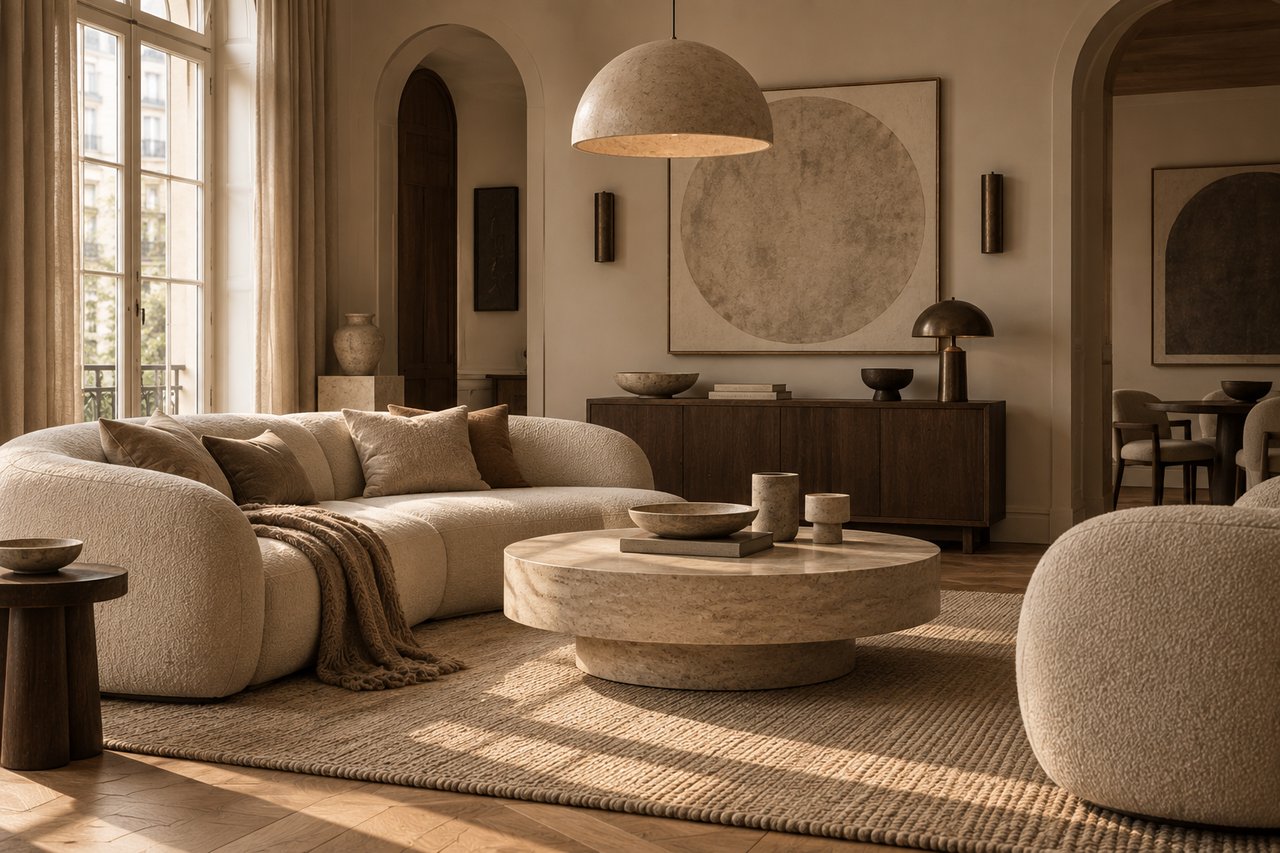
From the Pinterest board to the TikTok trend — and the question of who really shapes our taste.
Open Pinterest, Instagram or TikTok and start saving interiors you like. After a while, something strange happens. The feed gets better. The sofas feel more right. The kitchens more right. The lamps, colours and materials move closer to what you would choose yourself.
It can feel as though the algorithm has understood your taste.
But the process does not move in only one direction. Recommendation systems learn from what we click, save, watch and follow — and the selection they then show us becomes part of what we continue to be exposed to.
So the question is not only whether the algorithm knows us.
The more interesting question is what happens to our taste when the same system gets to help choose what we see, again and again.
A personal feed that can still feel strangely familiar
There is a paradox in today's culture of inspiration.
We have probably never had access to more interiors. In a few minutes, we can move between a flat in Stockholm, a house in Seoul, a renovated townhouse in London and a modernist home in Los Angeles.
At the same time, the feed can sometimes feel surprisingly uniform.
Dark wood appears everywhere at once. A particular type of stone table suddenly becomes hard to avoid. The same sofa, lamp or colour palette returns from account to account. Then the next wave arrives.
It would be tempting to conclude that algorithms have made our homes look the same.
It is not that simple.
There is not enough direct research to say that recommendation algorithms on Pinterest, Instagram or TikTok cause real homes to become more alike. There is, however, research into the mechanisms around them: recommendation systems shape which culture we are exposed to, can create feedback loops and, in simulations, have been shown to make user behaviour more homogeneous.
That is where this article begins.
Not with proof that all homes are becoming identical, but with the question of how our route to inspiration has changed.
The algorithm does not show us the world. It selects from it.
Pinterest itself describes how recommendations are based, among other things, on saves, searches, browsing activity, Pins viewed and boards.
TikTok describes the For You feed in similar terms: user interactions such as watching, liking, sharing, following, commenting and searching are combined with information about the content and other signals to rank what is likely to be relevant to an individual user.
Instagram, in turn, has described how recommendations gradually become personalised again after a reset, based on the content and accounts the user interacts with.
That does not mean all platforms work in the same way. Their models, goals and signals differ and also change over time.
But the principle matters:
The feed is a selection that reacts to our behaviour.
When we click on a room, that affects what the system can learn about us. When the system shows us the next room, that affects what we get the opportunity to respond to in the first place.
A loop forms.
Taste is not simply something the algorithm discovers
We often talk about personalisation as though our taste already existed fully formed inside us.
As though the task were simply to discover it.
Taste does not quite work like that.
It is influenced by experience, social context, history, economics, what is available in the market and what we are repeatedly exposed to. Algorithmic recommendation becomes another part of that environment.
In a study of Netflix's recommendation system, media researcher Fatima Gaw analyses how algorithmic processes participate in the construction of cultural taste, rather than merely reading it.
That does not mean research on Netflix can automatically be transferred to interiors. Film and the home are different cultural domains.
But it helps us articulate an important distinction:
A system that selects what we are exposed to cannot be entirely separated from the taste that is later measured through our responses to that same exposure.
This problem has also been studied technically.
Chaney, Stewart and Engelhardt showed in simulations how recommendation systems that learn from behaviour already influenced by previous recommendations can create a feedback loop. In their models, users' behaviour became more homogeneous without a corresponding increase in utility.
Jiang and colleagues have similarly analysed how recommendation systems and changing user preferences can influence one another over time and create degenerative feedback loops.
This is research on recommendation systems in general. It does not prove what happens to our living rooms.
But it shows why the question is reasonable.
When the familiar starts to feel right
There is something intuitive about what happens when an expression keeps returning.
At first, it feels unfamiliar.
Then familiar.
Eventually, it can feel obvious.
A 2026 study in the Journal of Cultural Economics models how engagement-driven curation can influence the way aesthetic taste develops over time. The model includes non-linear effects of familiarity: moderate exposure can increase appreciation of a style, while too much exposure can create saturation. The study also analyses how engagement-maximising curators can influence what users are exposed to.
Precision matters here.
This is a theoretical model, not an experiment that tracked people's homes before and after TikTok.
But it puts words to something central:
If exposure can help shape taste, the recommendation system is not merely a mirror of our preferences.
It becomes part of the environment in which those preferences develop.
The filter bubble is more real — and more complicated — than it sounds
The term filter bubble is often used loosely.
It can suggest a user being sealed inside a completely isolated universe where nothing unexpected can enter.
The research is more nuanced.
A 2023 systematic review found support for filter bubbles occurring in recommendation systems, while the literature it reviewed used different methods and also included studies that did not find the phenomenon. The review highlights greater diversity in recommendations as one possible part of the solution.
It is therefore not reasonable to say that personalisation always makes the world narrower.
A well-designed recommendation system can also introduce us to things we would never have found ourselves.
On TikTok, someone might discover a Japanese craftsperson, a furniture maker in another country or a historic flat that no Swedish magazine would have published.
On Pinterest, a single save can open a chain of visual references from entirely different periods and cultures.
The problem is therefore not that recommendation must lead to homogenisation.
The question is what kinds of recommendation a system rewards, how much novelty it introduces and which behaviours it uses as signals.
The strange paradox: personal to me, shared by millions
This is where the question becomes more interesting.
Two people do not need to receive identical feeds for their visual worlds to begin to overlap.
Research on cultural recommendation systems has also proposed that systems should be evaluated at population level, not only by whether one individual receives relevant and varied suggestions. Ferraro and colleagues, for example, introduce the measure commonality to assess the degree to which recommendations make certain categories of cultural content commonly familiar across a user population.
That opens up a paradox:
The feed can be highly personal and still contribute to shared aesthetic centres of gravity.
Millions of people can receive different combinations of content while certain images, products or aesthetics recur in a great many of those combinations.
This is not proof that this happens in interiors to any particular extent.
It is an analytical possibility that follows from the way personalised distribution and collective popularity can coexist.
The algorithm is not acting alone
It would also be historically short-sighted to blame social media for homogenisation.
Interiors have always had filters of taste.
Architects have influenced what is considered modern. Designers have introduced new ideals. Magazines have chosen which homes get to represent their time. Furniture fairs, department stores, television programmes, catalogues and advertising have spread some expressions far more widely than others.
Even before the internet, hundreds of thousands of homes could buy the same chair, wallpaper or kitchen.
What is new is not that someone selects what we see.
What is new includes the speed, scale, personalisation and feedback.
A magazine might select a hundred images for its readers.
An algorithmic feed can make continuously updated individual selections — and adjust future recommendations according to how we respond to earlier content.
That changes the distribution system, even if the human desire to imitate, belong and be inspired is much older.
When creators start creating for the feed
So far, we have treated the user as the recipient.
But the system also affects the person producing the content.
A creator sees which posts work. A stylist sees which images get saved. A brand sees which products gain traction. Platform metrics make the response visible almost immediately.
From there, it is not difficult to imagine the next step:
what works gets more variations.
More variations create more data.
More data makes it easier to recommend the same kind of content.
And a successful visual language can begin to be reproduced by people far outside the original circle.
This is Prestaged's editorial analysis, not something we can say research has specifically proven for interiors creators.
But it fits well with the feedback logic described in research on recommendation systems.
Then the trend leaves the screen
An interiors trend rarely stays inside a feed.
When enough people want something, something happens in the next layer.
Retailers can stock similar products.
Manufacturers can respond to demand.
Creators and brands can build on the same expression.
Alternatives at more price points can appear.
And once those objects enter real homes, they can be photographed, published and returned to the feed.
One possible loop therefore looks like this:
image → exposure → save → more images → demand → products → real homes → new images
The algorithm is only one actor in that loop.
Retail, creators, media, designers, manufacturers and all of us are others.
That is why it is misleading to ask whether “the algorithm” alone determines taste.
A more relevant question is how the whole system amplifies certain expressions once they start moving.
Prestaged is not outside the system
It is easy to write about Instagram, Pinterest and TikTok as though Prestaged stood outside the system and could observe it neutrally.
We do not.
Prestaged also selects.
Every environment we feature, every image we place first, every style we give its own guide and every image we leave out is an editorial act.
A curated inspiration platform is not neutral simply because the selection is made by people.
It is a filter.
The difference from an algorithm lies, among other things, in how the selection is made, why it is made and how transparent it is — not in one shaping taste while the other does not.
That also creates a responsibility.
If an inspiration platform shows the same palette, the same materials and the same kind of home again and again, it can itself contribute to making the aesthetic world narrower.
So breadth is not about showing everything.
It is about deliberately making room for more ways of living.
Classic and modern. Restrained and eclectic. Light and dark. Swedish and international. The perfect editorial feature and the personal home that does not follow this week's template.
Curation does not have to be neutral. But it can be conscious.
But the algorithm can also make our taste broader
There is another side that is easy to forget.
The same system that can reinforce the familiar can also make extremely niche culture accessible.
Someone who once had access to a few Swedish magazines and local shops can now discover:
a piece of furniture from the 1930s, an obscure architect from another country, a Japanese craft, an uncompromisingly colourful home, a building that has never appeared in major media, or a designer with a thousand followers.
That is an enormous expansion of the space for inspiration.
Pinterest describes how recommendations adapt to previous activity, and both TikTok and Instagram offer tools that give users some insight into, or control over, recommendations.
That means the relationship between algorithms and taste does not need to be a story of loss.
It can just as easily be a question of how we use an extremely powerful system for discovery without letting convenience replace curiosity.
Putting a little friction back in
Perhaps the most effective way to protect your own taste is not to leave social media.
It is to occasionally do something the algorithm has not already worked out.
Search instead of only scrolling. Type in a period, material or architect you do not usually look at.
Go backwards. Old magazines, books, museum collections and archives do not follow this week's recommendation logic.
Save what confuses you. Not only what feels immediately right.
Look at real homes. They contain compromises, inheritances, mistaken purchases, memories and things that would never appear in a perfect image carousel.
Start with the building. A home already has proportions, light, materials and history before the next trend arrives.
Wait. What still feels good after the feed has moved on is often more interesting than what felt obvious for three weeks.
And perhaps most importantly:
Sometimes ask why you like something.
Is it because it suits you?
Or because you have become very used to seeing it?
The personal home in the age of the personal algorithm
The algorithm does not know our home.
It does not know which scratches came from the children, which chair belonged to a grandfather, why we refuse to get rid of a table or how the afternoon light actually falls across the wall in November.
It sees behaviours and signals.
That makes recommendation systems excellent at finding the next image.
But a home is more than the next image.
And perhaps that is where real individuality still lives:
not in never being influenced, but in what we do with everything that has influenced us.
How Prestaged works with facts
Prestaged distinguishes between historical facts, traditional beliefs, modern interpretations and scientifically supported connections. Our features are fact-checked against academic and institutional sources. Where research is uncertain or disputed, we say so. Sources appear alongside relevant claims and are also collected below.
Newsletter
Prestaged Edit
Selected environments, guides, longer reads and details worth saving. Curated by Prestaged.
Sources & further reading
Pinterest Help. ”Refine your recommendations / Explore the home feed.”. Read the source
TikTok Newsroom. ”How TikTok recommends videos #ForYou.”. Read the source
TikTok Newsroom. ”Learn why a video is recommended For You.”. Read the source
Meta. ”Reshape Your Instagram With a Recommendations Reset.”, 2024. Read the source
Gaw, Fatima. ”Algorithmic logics and the construction of cultural taste of the Netflix Recommender System.”. New Media & Society, 2022. Read the source
Chaney, Allison J. B.; Stewart, Brandon M.; Engelhardt, Barbara E. ”How Algorithmic Confounding in Recommendation Systems Increases Homogeneity and Decreases Utility.”. RecSys 2018, 2018. Read the source Simulation study, not a study of real homes.
Jiang, Ray; Chiappa, Silvia; Lattimore, Tor; György, András; Kohli, Pushmeet. ”Degenerate Feedback Loops in Recommender Systems.”. AIES 2019, 2019. Read the source
Areeb, Qazi Mohammad m.fl. ”Filter bubbles in recommender systems: Fact or fallacy—A systematic review.”. WIREs Data Mining and Knowledge Discovery, 2023. Read the source
Knight, Samsun. ”Engagement-based curation and the evolution of taste.”. Journal of Cultural Economics, 2026. Read the source Theoretical model, not an experiment on real homes.
Ferraro, Andres; Ferreira, Gustavo; Diaz, Fernando; Born, Georgina. ”Measuring Commonality in Recommendation of Cultural Content: Recommender Systems to Enhance Cultural Citizenship.”, 2022. Read the source
A bed with a solid wall behind it. An entrance that feels open rather than blocked. Furniture that leaves natural routes through the room. Balance between light and dark, hard and soft, open and sheltered.