Prestaged fixes
Why does the room feel wrong? 7 common reasons
The furniture works beautifully on its own, yet the room still feels unfinished. Seven recurring reasons — and what to do about them.
Read the guideFrom Chinese site practice and cosmology to how we can think about our homes today.
A bed with a solid wall behind it. An entrance that feels open rather than blocked. Furniture that leaves natural routes through the room. Balance between light and dark, hard and soft, open and sheltered.

Many pieces of advice now described as feng shui can sound almost like ordinary interior-design knowledge. At the same time, feng shui contains a cosmology built around concepts such as qi, yin and yang and the five phases — ideas that should not be confused with modern natural science.
So what is feng shui, really? And can parts of the tradition be useful in a modern home without making claims that go beyond the evidence?
To understand that, we need to start long before today's bedrooms and Pinterest feeds.
There is no single moment when feng shui was “invented”. Practices with much in common with later feng shui appear in early Chinese historical sources, but under other names and within broader traditions of divination and cosmology. The term feng shui itself only became common during the Song dynasty, 960–1279. The further back in history we go, the harder it also becomes to separate feng shui from wider Chinese cosmology and divination.
Historically, site assessment was used for both buildings for the living and burial places for the dead. Homes, temples, palaces and other structures could be assessed according to principles that later became associated with feng shui.
It is therefore misleading to describe feng shui as originally being a method for choosing colours, placing mirrors or arranging living-room furniture. The broader historical question was closer to:
How should a human place relate to the world around it?
We can borrow the way of starting — without borrowing the whole explanatory model.
Look at the room first:
That is a modern design exercise, not a claim that doing so reproduces historical feng shui exactly as it was once practised.
A central part of feng shui has been the relationship to the physical site, its forms and directions. Different traditions have emphasised different methods. The literature often speaks, in simplified terms, of form-oriented and compass-oriented traditions. Compass-based feng shui uses, among other things, the specialised luopan compass. The history is also more complex than two completely separate and unchanging schools.
That matters, because otherwise feng shui can easily appear to be a single rule system that has remained unchanged throughout history.
It has not.
We can, however, translate a historically important question into modern interiors:
How does what is already there work before we start decorating?
A large sofa can be beautiful and still be in the wrong place if it blocks the room's main route.
A dining table can have perfect proportions and still cause frustration if every route to the kitchen passes through a chair.
An armchair can work better two metres away — not because an invisible force demands it, but because the geometry of the room does.
Prestaged principle: Understand the room before trying to improve it.
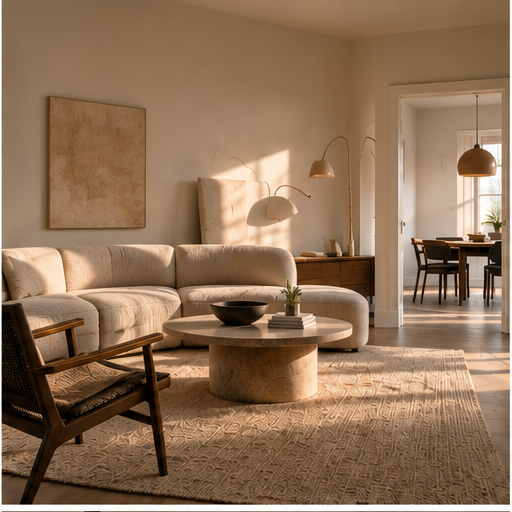
Qi is a central concept in Chinese philosophy and appears in many contexts far beyond feng shui. Simply translating it as the modern English word energy risks making the concept too simplistic. Chinese metaphysics has often understood reality as changing and relational, with yin and yang among the concepts used in broader cosmological reasoning.
At the same time, qi should not be confused with energy in the modern scientific sense. There is no established scientific evidence that qi is a measurable physical energy flowing through a room.
At home, the question of flow can be translated into something entirely concrete: how people move through the room.
Can you walk from the hall to the kitchen without taking a detour?
Do you have to squeeze past the coffee table every time you sit down?
Do two doors collide?
Does the main route pass straight through a seating group?
This is circulation and planning. We do not need a metaphysical explanation to recognise the difference between a room that is easy to move through and one that is frustrating.
Yin and yang belong to a much wider Chinese philosophical tradition than feng shui. They are used to describe contrasting and mutually related processes. They are not fixed properties of things: the same phenomenon can be understood differently depending on relationship and context.
That is why the popular simplification yin = dark, yang = light is too crude.
As inspiration, however, it can help us notice when a room has become too one-sided.
Imagine a living room where almost everything is:
It may be calm and beautiful. But if it also feels flat, the answer may not be another beige textile.
It may instead need a dark timber surface, shiny metal, a straighter form, a rougher stone, something taller or an object with greater visual weight.
Here, yin and yang are used as inspiration for a question of relationship and contrast — not as scientific design theory.
Wuxing is often translated as “the five elements”: wood, fire, earth, metal and water.
In philosophical accounts, translations such as five phases or five processes are also used, because the system describes dynamic and interdependent processes rather than five fixed material building blocks.
In modern interior feng shui, the five phases are often used as a practical framework and represented through materials, colour, light and objects, among other things.
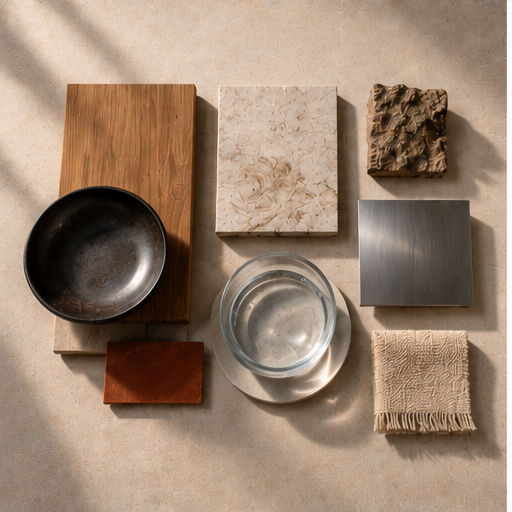
For a modern home, that can work as a way of noticing variation in materials and expression:
This is a modern interior interpretation of an older cosmological system, not a scientifically established formula for how much of each category a home needs.
The more useful question becomes:
Does the room have enough variation in material, temperature, sheen, texture and visual weight?
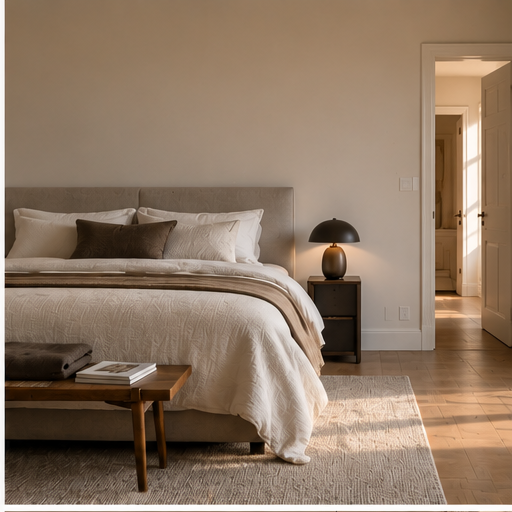
In modern feng shui, the so-called command position is a common principle. For a bed or desk, for example, it usually means that the person can see the door without the furniture sitting directly in line with it.
There is, however, no evidence that today's exact command-position rule has been practised unchanged throughout the entire history of feng shui.
Place a desk in two different positions.
In the first, sit with your back to the entrance to the room.
In the second, have a wall or another stable backdrop behind you while keeping the door and most of the room in view.
Which position feels better to work in?
There is an interesting parallel with environmental psychology's prospect-refuge theory, which deals, among other things, with outlook and shelter. But the research is mixed. A meta-analysis of 34 quantitative studies found that results varied across natural, urban and architectural/interior environments, and that the overall evidence was not sufficient to confirm the theory unequivocally.
Environmental psychology therefore does not provide scientific proof of the command position as a feng shui rule. Research into related questions such as outlook, sightlines and the experience of shelter does, however, make placement interesting to test as a practical design move.
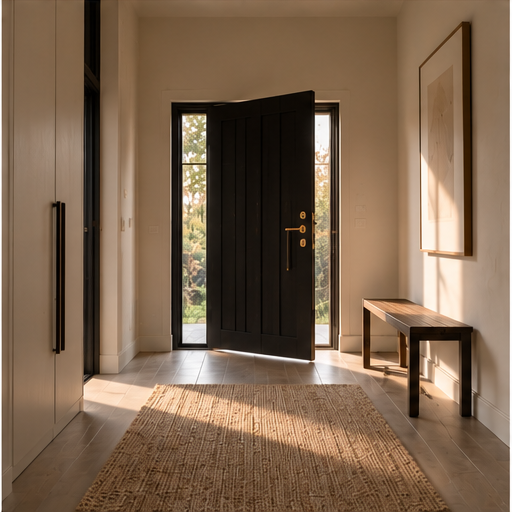
In modern feng shui, the front door is often described as the place where qi “enters” the home, which is why an open and welcoming entrance is a recurring piece of advice. This is a modern feng shui belief, not a scientific claim.
When you come through the door:
A good hall does not need to be empty or minimalist.
It needs to work as a transition between outside and inside.
In some areas, modern research can be discussed entirely independently of feng shui. One clear example is daylight.
A systematic research review published in 2024 in the Journal of Environmental Psychology examined 33 studies of daylight indoors. The findings offered promising support for restorative effects from more, or more natural, daylight, particularly for some affective and clinical outcomes. At the same time, the results were not consistently positive: almost half of the relationships examined produced null findings.
Modern daylight research does not validate feng shui as a system. It does, however, show that the effect of light on people is a relevant field of research in its own right.
Do not only ask:
Does the room have a lot of light?
Also ask:
A living room that works at 1 pm may need completely different light sources at 9 pm.
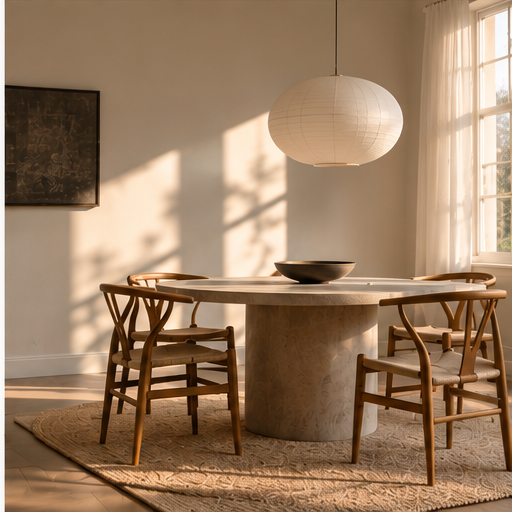
Modern feng shui places considerable emphasis on the position of the bed, often with a view across the room and without the bed sitting directly in line with the door.
There is, however, no scientific evidence that a particular arrangement of this kind in itself improves luck, relationships or life energy.
Ask instead:
In this way, feng shui becomes a way to investigate the bedroom, rather than a rulebook to follow.
A living room is rarely just a room for furniture. It is often a place for conversation, television, reading, guests, rest and movement all at once.
That is why the same seating arrangement can work beautifully in one home and badly in another.
Here, feng shui's focus on placement and movement can be used as inspiration.
Sit in every important position in the room.
It is a modern way to read the room through relationships and movement.
It is easy to begin a home office with the desk lamp, chair and storage.
Try the position itself first.
The command position can work here as an experiment.
Move the desk. Work there for a while. Notice how it feels.
Different positions can create clearly different experiences of the same room without requiring a metaphysical explanation.
No.
Popular feng shui is often associated with order and clear walkways, but a well-functioning home does not need to be minimalist.
A home can be rich in books, art, ceramics and personal objects and still be easy to use.
A more useful question is:
Can the room still do what you want it to do?
A bookcase full of books can be completely intentional.
A dining chair permanently serving as a storage pile is something else.
The difference is not necessarily about more or less.
It is about intention and function.
In modern times, feng shui has spread far beyond its Chinese cultural context. In Western settings, the tradition has been reinterpreted and linked, among other things, to environmental thinking and new applications. Ole Bruun describes how, in the West from the 1960s onwards, feng shui became associated with concepts such as landscape, environment, nature and ecology and was coloured by Western ideas.
That means what is presented as feng shui in a modern European interiors context can differ considerably from older Chinese practices.
The phrase “in modern feng shui” is therefore often more precise than describing a contemporary interiors recommendation as though it were a timeless rule.
A systematic review published in 2023 identified and reviewed 36 empirical and quantitative feng shui papers using PRISMA 2009. The studies varied widely in both method and subject, and the researchers themselves concluded that the evidence should be interpreted cautiously because of factors including the small number of studies, variable quality and low generalisability.
The review found some associations — including between feng shui and certain environmental characteristics — but effects on people were not consistent. It therefore does not provide a basis for describing feng shui as a scientifically verified system as a whole.
To understand what is actually supported, it helps to distinguish between four levels:
What historical and academic sources can establish about the development and use of feng shui.
For example, qi and cosmological relationships within the tradition.
For example, today's command position and common modern interior interpretations.
For example, research into daylight and environmental preferences.
The fact that two areas sometimes lead to similar advice does not mean one proves the other.
That depends on what we mean by work.
There is not enough scientific evidence to say that positioning furniture in a particular way through qi improves, for example, finances, love or health. Nor does the 2023 systematic review provide a basis for describing feng shui as a scientifically verified system as a whole.
But feng shui can still offer interesting questions about place, direction, movement, light, relationships and balance:
Perhaps that is not mystical at all.
But it can make us look at our homes with a little more attention.
Feng shui does not have to be an answer for how a home should look. It can be a way to start seeing the room before we start changing it.
Prestaged distinguishes between historical facts, traditional beliefs, modern interpretations and scientifically supported connections. Our features are fact-checked against academic and institutional sources. Where research is uncertain or disputed, we say so. Sources appear alongside relevant claims and are also collected below.
Selected environments, guides, longer reads and details worth saving. Curated by Prestaged.
The furniture works beautifully on its own, yet the room still feels unfinished. Seven recurring reasons — and what to do about them.
Read the guideSeating, lighting and a correctly sized rug matter more than colour. How to plan a living room that works all week.
Read the guideBlackout, a headboard and layered lighting shape how the room works. How to plan a bedroom around sleep first, appearance second.
Read the guide