Room guide
Kitchen – materials that last
Worktops, working space and three layers of light. Kitchen decisions can stay with you for decades — here's how to get the foundations right.
Read the guideWood, stainless steel, colour and kitchens that feel more like rooms than systems.
The white kitchen is not disappearing. But its unquestioned dominance is. After years of flat fronts, pale stone and almost invisible architecture, kitchens are gaining more material, more furniture-like character and more personality.
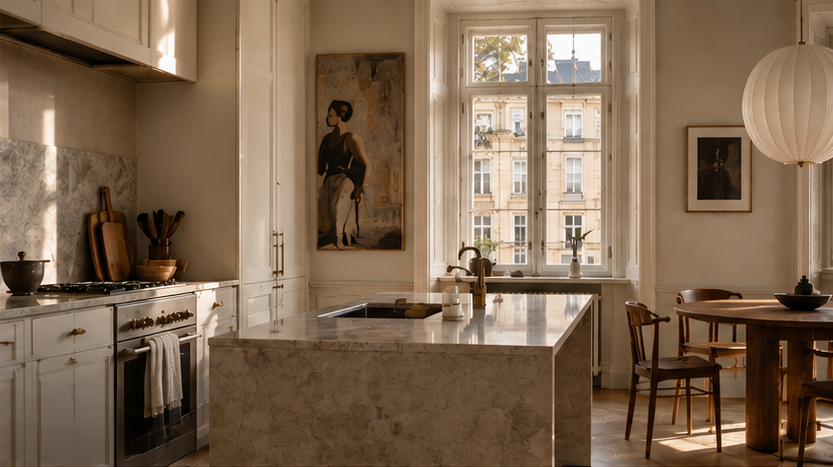
The white kitchen is not gone.
That is the important place to start.
In Houzz's 2026 U.S. Kitchen Trends Study, 28 per cent of renovating homeowners chose white cabinets. That makes white the second most popular choice.
But for the first time in a long while, wood came out just ahead.
29 per cent chose wood — up six percentage points on the previous year — while white fell by five. Medium-toned wood accounted for the largest share of wood choices, followed by light and dark wood.
This is American renovation data, not Swedish market statistics.
But the shift is interesting.
Not because it proves the white kitchen is on its way out.
But because it shows that something else has begun to feel just as natural.
It is easy to forget why white kitchens became so dominant.
White is easy to combine.
It reflects light.
It works in small rooms and large ones.
It is easy for a developer to standardise.
It is easy for a buyer to accept.
And for a long time it signalled what a kitchen was expected to signal:
clean, modern, bright, new.
That made the white kitchen extremely effective.
But also extremely reproducible.
When enough kitchens have flat white fronts, pale stone, recessed spotlights and integrated appliances, they begin to look alike.
That is where the next shift becomes interesting.
Wood in kitchens is, of course, nothing new.
What is new is how it is used.
For many years, wood was often very pale, even and visually discreet.
Now we see more grain.
More tone.
More variation.
And above all, a greater willingness to let the material actually feel like wood.
Houzz's 2026 data shows medium-toned wood as the largest wood group, at 15 per cent, followed by light wood at 11 per cent and dark wood at 3 per cent.
This does not mean everything is heading towards dark walnut kitchens.
But it supports a broader movement towards warmth and materiality.
What might once have seemed too heavy is starting to feel more grounded.
A wooden kitchen does not have to be rustic.
It can be extremely restrained.
The difference is that the surface is allowed to carry the expression.
At home, stainless steel has long had two clear roles:
appliances and the sink.
When the material moves beyond those roles, something happens.
An entire worktop.
A kitchen island.
A cabinet.
A splashback.
A shelf.
Suddenly it is not just technical.
It becomes architecture.
In Houzz's 2026 data, stainless steel still dominates appliances: 72 per cent of renovating homeowners choose a stainless finish.
But from a design perspective, what is interesting is how the material works with warmer surfaces.
Stainless steel against dark wood.
Stainless steel against oak.
Stainless steel against limestone.
The coolness of the metal makes the wood warmer.
The wood makes the metal less industrial.
It is often the combination that works.
Not the all-stainless kitchen.
The walls in many kitchens remain neutral.
In Houzz's 2026 study, off-white was the top wall colour, followed by white.
But the cabinets need not be.
Green came in at 6 per cent, overtaking grey at 5 per cent in their data. Blue, beige, black and greige were lower.
The figures are hardly revolutionary.
But they show something important:
colour no longer has to be something applied on top of the kitchen.
It can be the kitchen.
A deep green front.
A reddish-brown island.
A blue-grey tall cabinet.
A beige kitchen with a warmer undertone.
It creates a different kind of presence than when all the colour comes from walls, chairs and accessories around a neutral system.
For a long time, one ideal was to make the kitchen disappear.
Handleless.
Integrated.
Tone on tone.
Appliances behind fronts.
The extractor hidden.
Functions tidied away.
It can be very beautiful.
But it can also make the kitchen start to resemble a wall.
Now an opposing direction is emerging at the same time:
open shelves, freestanding cabinets, contrasts in material, lamps with a distinct form, visible metal elements, worktops that are allowed to be worktops.
The kitchen is allowed to look like a room where something happens.
Not just a system that would rather not be seen.
One of the clearest changes is how the kitchen island is treated.
It may still contain a sink, storage and a worktop.
But visually it increasingly has an identity of its own.
A different colour.
A different material.
More pronounced legs or plinth.
Stone that wraps around the sides.
Or wood that clearly stands apart from the rest of the kitchen.
Houzz's 2026 data also shows butcher block growing as an island material, while stone and other surfaces continue to dominate more broadly.
What is interesting is not a specific material.
It is the idea that the island can be treated as an object in the room, rather than an extension of the run of cabinets.
At the same time, the contemporary kitchen is becoming more functional, not less.
Houzz reports that 76 per cent of renovating homeowners in its 2026 study are adding specialty built-in features. Among them are pantry cabinets, walk-in pantries, beverage stations and dedicated baking stations.
That is interesting because it points in a different direction from "more things on display".
It is more about:
more character where you see it, more function where you don't.
The coffee machine can have its own place.
Small appliances can be hidden away.
Storage can be planned around real routines.
That allows the rest of the kitchen to feel freer.
Tiles are not going to disappear.
But large continuous splashbacks in the same material as the worktop have become more common.
Houzz singles out slab backsplashes as a distinct feature of 2026 kitchen renovations.
It changes the kitchen visually.
Fewer grout lines.
Fewer small lines overall.
Larger expanses of a single material.
It also leaves more room for wood, metal and other details to be seen.
In a kitchen with a lot of character in its fronts, that may be exactly what is needed:
a calm backdrop.
The perfect kitchen is easiest to photograph in its first week.
The interesting kitchen has to work in year ten.
That is where material choices change.
Solid wood marks.
Brass changes tone.
Stainless steel scratches.
Limestone stains.
Marble etches.
For a long time, all of this was seen as a problem to avoid.
But as interest in more material-led kitchens grows, the question changes:
can we accept a kitchen that looks used?
Not everyone wants patina.
But a material that visibly ages can also offer something a perfect surface never can:
time.
Nor does it need to.
White can still be exactly right.
In a dark room.
In an older house where the architecture should lead.
In a small kitchen.
Or simply for those who like it.
What is changing is rather that white no longer has to be the default that comes before every other choice.
In Houzz's 2026 data, the gap between wood and white is just one percentage point.
It is therefore fairer to describe the development as a broadening than as a shift from one trend to another.
The kitchen gains more possible expressions.
Not a brown kitchen.
Not a green kitchen.
Not a stainless-steel kitchen.
What follows the white kitchen's dominance seems rather to be a kitchen in which material matters more than neutrality.
Wood is allowed to look like wood.
Metal is allowed to look like metal.
Stone is allowed to age.
Colour can live in the cabinets themselves.
And the kitchen can once again be a visible part of the home's character.
Prestaged note: Perhaps what is interesting after the white kitchen is not which colour takes over. It is that the kitchen no longer has to try to disappear.
Prestaged distinguishes between historical facts, traditional beliefs, modern interpretations and scientifically supported connections. Our features are fact-checked against academic and institutional sources. Where research is uncertain or disputed, we say so. Sources appear alongside relevant claims and are also collected below.
Selected environments, guides, longer reads and details worth saving. Curated by Prestaged.
Worktops, working space and three layers of light. Kitchen decisions can stay with you for decades — here's how to get the foundations right.
Read the guideVisible grain, a hard-wearing surface and enough weight to anchor a room without making it dark. How to combine dark oak.
Read the guideDurable, honest and finished with a soft matt sheen that ages well. How to avoid the professional-kitchen look.
Read the guideTravertine, limestone and marble belong to the same family but behave very differently. How to choose the right one.
Read the guide