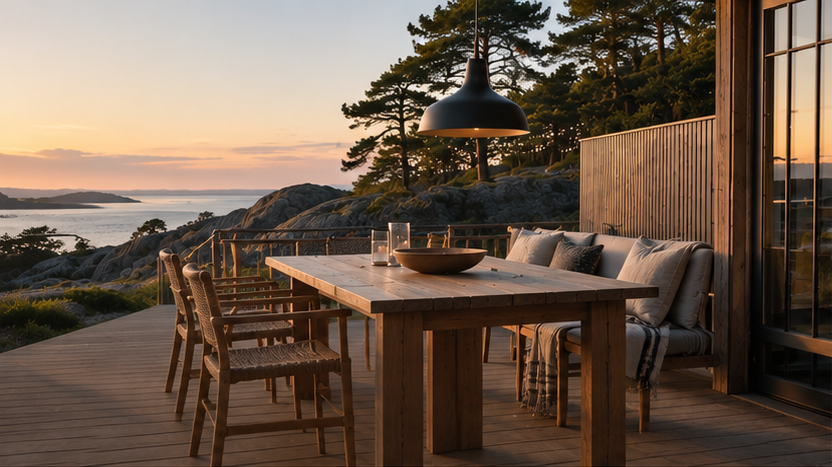
Warm tones, generous shade, portable light and outdoor spaces that no longer feel secondary.
Outdoor living is no longer the place where simpler versions of indoor furniture migrate every spring. In 2026, the mood is softer, more architectural and far more considered. We have selected five directions that feel relevant well beyond a single season.
The most interesting thing about outdoor living in 2026 is not that it has gained more products.
It is that it has gained more confidence.
At Maison&Objet in Paris, Outdoor Living had its own area, with around 50 international brands across furniture, pergolas, lighting, rugs and accessories. The organisers themselves described how the line between the outdoor armchair and the living-room armchair has become increasingly blurred.
Houzz saw the same shift in its coverage of the fair: richer colours, more sophisticated lounge furniture and portable lighting emerged as recurring themes.
Less "garden furniture".
More room.
Here are five directions we are taking with us.
01 / Rust & terracotta
The clearest colour shift outdoors is away from black, grey and pale wood alone.
Rust, terracotta, amber and deeper orange tones appeared again and again at Maison&Objet 2026.
What is interesting is that they behave differently outside than in.
Against greenery, they turn earthy.
Against stone, they grow warmer.
Against dark wood, they take on an almost 1970s feel without becoming retro.
It does not have to mean an entire terracotta lounge set.
A chair.
A parasol.
A lacquered metal frame.
A small lamp.
Or a textile.
Prestaged note: Use colour as an accent in an otherwise material-led outdoor space. A single piece is often enough.
02 / Portable light
The small rechargeable lamp has become one of the most useful design shifts for outdoor living.
Not because the technology is new.
But because the form has improved.
At Maison&Objet 2026, several small portable lamps were designed to move between indoors and out, rather than looking like technical camping lights.
It changes the whole evening atmosphere.
The light can sit in the middle of the table.
Move to the side table.
Follow you to the steps.
Rest beneath a tree.
And above all:
it allows everything else to stay dark.
The look: a low light source, warm colour temperature, a simple silhouette, no glare from above.
03 / The oversized parasol
The parasol has long been something practical, added as an afterthought.
Now it is increasingly treated as part of the architecture.
In 2026, Maison&Objet highlighted both more luxurious parasols and more considered shade solutions within its Outdoor Living area.
It is not only about shade.
A large parasol:
creates a visual ceiling
gathers a dining area
lends scale to a larger terrace
can carry colour or pattern so the rest of the space does not have to
A small parasol in the middle of a large furniture arrangement often looks like an accessory.
Generous shade, by contrast, can become the element that defines the entire room.
04 / Indoor proportions, outdoor materials
Outdoor furniture is getting softer.
Deeper seats.
More enveloping forms.
More textiles.
Less of the stackable chair, more of the living room.
Maison&Objet describes how today's outdoor armchair increasingly approaches a well-drawn indoor lounge chair, while its materials and construction are still made for the weather.
Houzz also noted more resort-like lounge furniture at the fair — with references ranging from Art Deco to Palm Springs and the French Riviera.
It is a direction we like.
Not because the terrace should become a hotel.
But because comfort is finally allowed to matter as much outside as in.
The look: broad armrests, softer lines, thicker cushions, a clearer silhouette.
05 / One material, not five
Even as furniture becomes more expressive, the best spaces are often calmer in their choice of materials.
It is an important contrast.
A limestone terrace.
One dark wood.
One metal.
A few textiles.
Not five species of wood, three metals and two kinds of stone.
Maison&Objet highlighted both rich texture and more refined material solutions, but what matters most is how they work together rather than how many there are.
It is the same principle as indoors:
the clearer the base, the more a single object can speak.
What we are leaving behind
Not every trend needs to become part of the home.
What appears at a trade fair is not automatically something to copy.
We would be cautious with:
complete furniture sets
an overdone resort theme
too much black metal
decorative outdoor gadgets without purpose
pattern on every surface at once
The most interesting thing about 2026 is not maximal styling.
It is rather that the outdoor space is beginning to be treated with the same precision as the rest of the home.
Prestaged edit
If we were to distil the whole outdoor direction for 2026 into five things:
a warmer colour, a better chair, bigger shade, a small lamp, and fewer materials.
That goes a long way.
Sources & further reading
All Eyes on Outdoor Furniture!. Maison&Objet, 2025. Read the source Maison&Objet's presentation of its Outdoor Living area ahead of the January 2026 fair.
5 Outdoor Living Trends to Watch in 2026. Houzz. Read the source Editorial coverage of Maison&Objet 2026. Used as an international trend indicator, not as Swedish market data.
A considered outdoor space does not begin with the sofa. It begins with the same questions as a good living room: where do we want to sit, how do we move through the space, where does the light fall and which material should lead?